A.5 Chapter 5

Exercise 5.4

Fix aa\in\mathbb{R} and h{0}h\in\mathbb{R}\setminus\{0\} and consider the difference quotient

f(a+h)f(a)h=m(a+h)+cmach=mhh=m.\frac{f(a+h)-f(a)}{h}=\frac{m(a+h)+c-ma-c}{h}=\frac{mh}{h}=m.

From this, we see that

limh0f(a+h)f(a)h=m\lim_{h\to 0}\frac{f(a+h)-f(a)}{h}=m

and so ff is differentiable at aa with f(a)=mf^{\prime}(a)=m. Since aa\in\mathbb{R} was arbitrary, we conclude f:f\colon\mathbb{R}\to\mathbb{R} is differentiable.

Exercise 5.9

Considering h>0h>0, we have

limh0+f(0+h)f(0)h=limh0+hh=1,\lim_{h\to 0_{+}}\frac{f(0+h)-f(0)}{h}=\lim_{h\to 0_{+}}\frac{h}{h}=1,

while for h<0h<0 we have

limh0f(0+h)f(0)h=limh0h2h=limh0h=0.\lim_{h\to 0_{-}}\frac{f(0+h)-f(0)}{h}=\lim_{h\to 0_{-}}\frac{h^{2}}{h}=\lim_{% h\to 0_{-}}h=0.

Since the one-sided limits do not agree, the limit limh0f(0+h)f(0)h\displaystyle\lim_{h\to 0}\frac{f(0+h)-f(0)}{h} does not exist (by the result of Exercise 4.72).

Hence, ff is not differentiable at 0.

Exercise 5.14

(i) Using the result of Exercise 4.46, observe that

limh0cos(0+h)cos(0)h=limh0cos(h)1h=0.\lim_{h\to 0}\frac{\cos(0+h)-\cos(0)}{h}=\lim_{h\to 0}\frac{\cos(h)-1}{h}=0.

Thus, by definition, cos(0)=0\cos^{\prime}(0)=0.

(ii) Fix aa\in\mathbb{R} and h{0}h\in\mathbb{R}\setminus\{0\} and consider the difference quotient

sin(a+h)sin(a)h\displaystyle\frac{\sin(a+h)-\sin(a)}{h} =sin(a)cos(h)+sin(h)cos(a)sin(a)h\displaystyle=\frac{\sin(a)\cos(h)+\sin(h)\cos(a)-\sin(a)}{h}
=sin(a)cos(h)1h+cos(a)sin(h)h.\displaystyle=\sin(a)\frac{\cos(h)-1}{h}+\cos(a)\frac{\sin(h)}{h}.

Taking the limit as h0h\to 0 and applying the limit laws and the definition of the derivative, we see sin\sin is differentiable at aa with

sin(a)=sin(a)cos(0)+cos(a)sin(0)=cos(a).\sin^{\prime}(a)=\sin(a)\cos^{\prime}(0)+\cos(a)\sin^{\prime}(0)=\cos(a).

Here we used the fact that sin(0)=1\sin^{\prime}(0)=1, which was already proven in Example 5.13, and cos(0)=0\cos^{\prime}(0)=0, which was proven in part (i).

The same argument can also be applied to cos\cos. Alternatively, we can also derive the formula for cos\cos^{\prime} from that of sin\sin^{\prime} using the fact that cos(θ)=sin(θ+π/2)\cos(\theta)=\sin(\theta+\pi/2) for all θ\theta\in\mathbb{R}. Indeed, fix aa\in\mathbb{R} and h{0}h\in\mathbb{R}\setminus\{0\} and consider the difference quotient

cos(a+h)cos(a)h=sin(a+π/2+h)sin(a+π/2)h.\frac{\cos(a+h)-\cos(a)}{h}=\frac{\sin(a+\pi/2+h)-\sin(a+\pi/2)}{h}.

Taking the limit as h0h\to 0, we see that cos\cos is differentiable at aa with

cos(a)=sin(a+π/2)=cos(a+π/2)=sin(a),\cos^{\prime}(a)=\sin^{\prime}(a+\pi/2)=\cos(a+\pi/2)=-\sin(a),

as required.

Exercise 5.16

We prove by a very simple induction that exp:\exp\colon\mathbb{R}\to\mathbb{R} is nn-times differentiable for all nn\in\mathbb{N} with exp(n)=exp\exp^{(n)}=\exp.

Base case: We know from Lemma 5.12 that exp\exp is differentiable with exp=exp\exp^{\prime}=\exp, which provides the base case for the induction.

Inductive step: Let nn\in\mathbb{N} and suppose, as an induction hypothesis, that exp\exp is nn-times differentiable with exp(n)=exp\exp^{(n)}=\exp. Since, again by Lemma 5.12, exp\exp is differentiable with exp=exp\exp^{\prime}=\exp, it follows that exp(n)\exp^{(n)} is differentiable with exp(n+1)=(exp(n))=exp=exp\exp^{(n+1)}=(\exp^{(n)})^{\prime}=\exp^{\prime}=\exp, as required. This closes the induction and completes the proof.

Exercise 5.17

From earlier exercises and examples we know that

p2(1)(x)=2x,p2(2)(x)=2andp2(n)(x)=0for all n3 and all x;p_{2}^{(1)}(x)=2x,\quad p_{2}^{(2)}(x)=2\quad\text{and}\quad p_{2}^{(n)}(x)=0% \quad\text{for all $n\geq 3$ and all $x\in\mathbb{R}$;}

in particular, p2(n)p_{2}^{(n)} exists for all nn\in\mathbb{N}. Therefore, the function p2p_{2} is infinitely differentiable, and consequently it is also twice differentiable and three times differentiable.

Exercise 5.22
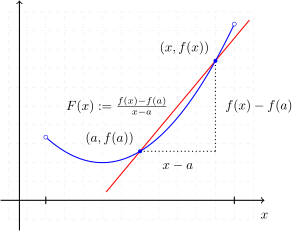
Figure A.4: The function F:IF\colon I\to\mathbb{R} from Exercise 5.22.

For xI{a}x\in I\setminus\{a\}, the value F(x)F(x) corresponds to the gradient of the secant line between the points (a,f(a))(a,f(a)) and (x,f(x))(x,f(x)) on the graph of ff; see Figure A.4. On the other hand, F(a)F(a) corresponds to the gradient of the tangent line.

Exercise 5.23

Let f:f\colon\mathbb{R}\to\mathbb{R} be the sine function f(x):=sinxf(x):=\sin x for all xx\in\mathbb{R} and a=0a=0. Then f(0)=0f(0)=0 and f(0)=1f^{\prime}(0)=1 and, correspondingly, we have

F:;F(x):={sinxxif x{0},1if x=0.F\colon\mathbb{R}\to\mathbb{R};\qquad F(x):=\begin{cases}\displaystyle\frac{% \sin x}{x}&\text{if $x\in\mathbb{R}\setminus\{0\}$,}\\ 1&\text{if $x=0$.}\end{cases}

That is, F=sincF=\mathrm{sinc} is precisely the sinc\mathrm{sinc} function from Example 4.44, which we know is continuous.

Exercise 5.25

Let II\subseteq\mathbb{R} be an open interval, ff, g:Ig\colon I\to\mathbb{R} be differentiable at aIa\in I. Thus, by definition

f(a):=limh0f(a+h)f(a)handg(a):=limh0g(a+h)g(a)h.f^{\prime}(a):=\lim_{h\to 0}\frac{f(a+h)-f(a)}{h}\qquad\text{and}\qquad g^{% \prime}(a):=\lim_{h\to 0}\frac{g(a+h)-g(a)}{h}.

Let λ\lambda\in\mathbb{R} and consider the difference quotients

λf(a+h)λf(a)h=λf(a+h)f(a)h\frac{\lambda f(a+h)-\lambda f(a)}{h}=\lambda\frac{f(a+h)-f(a)}{h}

and

(f+g)(a+h)(f+g)(a)h=f(a+h)f(a)h+g(a+h)g(a)h.\frac{(f+g)(a+h)-(f+g)(a)}{h}=\frac{f(a+h)-f(a)}{h}+\frac{g(a+h)-g(a)}{h}.

Hence, by the limit laws,

(λf)(a)=limh0λf(a+h)λf(a)h=λlimh0f(a+h)f(a)h=λf(a)(\lambda f)^{\prime}(a)=\lim_{h\to 0}\frac{\lambda f(a+h)-\lambda f(a)}{h}=% \lambda\lim_{h\to 0}\frac{f(a+h)-f(a)}{h}=\lambda f^{\prime}(a)

and

(f+g)(a)\displaystyle(f+g)^{\prime}(a) =limh0(f+g)(a+h)(f+g)(a)h\displaystyle=\lim_{h\to 0}\frac{(f+g)(a+h)-(f+g)(a)}{h}
=limh0f(a+h)f(a)h+limh0g(a+h)g(a)h=f(a)+g(a).\displaystyle=\lim_{h\to 0}\frac{f(a+h)-f(a)}{h}+\lim_{h\to 0}\frac{g(a+h)-g(a% )}{h}=f^{\prime}(a)+g^{\prime}(a).

Thus, by definition, both λf\lambda f and f+gf+g are differentiable at aa and the derivatives are given by the above formulæ.

Exercise 5.32

Consider the function pn:(0,)(0,)p_{n}\colon(0,\infty)\to(0,\infty) given by pn(x):=xnp_{n}(x):=x^{n} for all x>0x>0. We know that f=pn1f=p_{n}^{-1} is the inverse of pnp_{n}. Furthermore, from Example 5.11, we know that pnp_{n} is differentiable with pn(x)=nxn1>0p_{n}^{\prime}(x)=nx^{n-1}>0 for all xx\in\mathbb{R}. Since the derivative of pnp_{n} is nonvanishing on (0,)(0,\infty), we may apply the differential inverse function theorem to conclude that ff is differentiable with

f(x)=(pn1)(x)=1pn(f(x))=1n(x1/n)n1=x1+1/nn,for all x>0,f^{\prime}(x)=(p_{n}^{-1})^{\prime}(x)=\frac{1}{p_{n}^{\prime}(f(x))}=\frac{1}% {n(x^{1/n})^{n-1}}=\frac{x^{-1+1/n}}{n},\qquad\text{for all $x>0$,}

as required.

Exercise 5.35

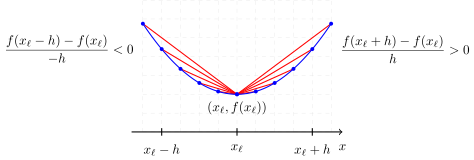
An illustration of the proof of the Theorem 5.34. Here xx_{\ell} is a local maximum of the differentiable function ff and h>0h>0. The secant line between (x,f(x))(x_{\ell},f(x_{\ell})) and a point (x+h,f(x+h))(x_{\ell}+h,f(x_{\ell}+h)) lying to the right has a positive gradient. The secant line between (x,f(x))(x_{\ell},f(x_{\ell})) and a point (xh,f(xh))(x_{\ell}-h,f(x_{\ell}-h)) lying to the left has a negative gradient. This observation forces f(x)=0f^{\prime}(x_{\ell})=0.

Exercise 5.38

(i) Consider the function f:[0,1]f\colon[0,1]\to\mathbb{R} given by

f(x):={xif 0x<1,0if x=1.f(x):=\begin{cases}x&\text{if $0\leq x<1$,}\\ 0&\text{if $x=1$.}\end{cases}

Then f(0)=f(1)=0f(0)=f(1)=0 and ff is differentiable on (0,1)(0,1), since on this interval it agrees with the linear function :\ell\colon\mathbb{R}\to\mathbb{R} given by (x):=x\ell(x):=x. Note, however, ff is not continuous on [0,1][0,1]. Furthermore, for all c(0,1)c\in(0,1) we have f(c)=(c)=10f^{\prime}(c)=\ell^{\prime}(c)=1\neq 0, so the conclusion of the Rolle’s theorem fails for this function. This shows that the hypothesis that ff is continuous on the closed interval [a,b][a,b] is necessary to ensure the conclusion of the theorem always holds.

(ii) Consider the function f:[1,1]f\colon[-1,1]\to\mathbb{R} given by f(x):=|x|1f(x):=|x|-1 for all x[1,1]x\in[-1,1]. Then f(1)=f(1)=0f(-1)=f(1)=0 and ff is continuous on [1,1][-1,1] and differentiable on (1,1){0}(-1,1)\setminus\{0\} with

f(x)={1if 1<x<0,1if 0<x<1.f^{\prime}(x)=\begin{cases}-1&\text{if $-1<x<0$,}\\ 1&\text{if $0<x<1$.}\end{cases}

Note, however, that ff is not differentiable at 0. Furthermore, from the above we see f(c)0f^{\prime}(c)\neq 0 for all c(1,1){0}c\in(-1,1)\setminus\{0\}. This shows that the hypothesis that ff is differentiable everywhere on the open interval (a,b)(a,b) is necessary to ensure the conclusion of Rolle’s theorem always holds.

Exercise 5.39
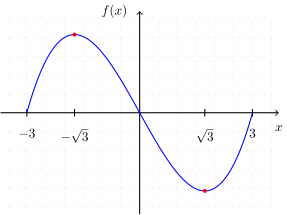
Figure A.5: The function f(x):=x39xf(x):=x^{3}-9x from Exercise 5.39.

We know that any polynomial p:p\colon\mathbb{R}\to\mathbb{R} function is differentiable (and therefore also continuous). Since f:[3,3]f\colon[-3,3]\to\mathbb{R} given by f(x):=x39xf(x):=x^{3}-9x is the restriction of a polynomial, ff is continuous on [3,3][-3,3] and differentiable on (3,3)(-3,3). Furthermore,

f(3)=3393=0=(3)39(3)=f(3).f(3)=3^{3}-9\cdot 3=0=(-3)^{3}-9\cdot(-3)=f(-3).

Thus, ff satisfies the hypotheses of Rolle’s theorem so we know there exists some point c(3,3)c\in(-3,3) satisfying f(c)=0f^{\prime}(c)=0.

In fact, by a simple computation we can show ff has precisely two such stationary points. Indeed,

f(x)=3x29=3(x23)=3(x+3)(x3)f^{\prime}(x)=3x^{2}-9=3(x^{2}-3)=3(x+\sqrt{3})(x-\sqrt{3})

and so ff^{\prime} has precisely two roots: 3\sqrt{3} and 3(3,3)-\sqrt{3}\in(-3,3). See Figure A.5.

Exercise 5.40

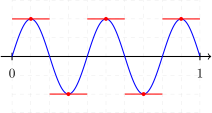
Figure A.6: A function f:[0,1]f\colon[0,1]\to\mathbb{R} illustrating Rolle’s theorem. Note that f(0)=f(1)f(0)=f(1), so Rolle’s theorem guarantees the existence of a stationary point ξ(0,1)\xi\in(0,1) with f(ξ)f^{\prime}(\xi). In fact, here there are precisely 55 such points.

A typical example is f:[0,1]f\colon[0,1]\to\mathbb{R} given by f(x):=sin(5πx)f(x):=\sin(5\pi x), which has graph sketched in Figure A.6. Conceptually, the graph of the function should either 33 peaks and 22 troughs or 22 peaks and 33 troughs, so any sketch which incorporates these essential features works.

Exercise 5.42

Suppose f:[a,b]f\colon[a,b]\to\mathbb{R} satisfies the hypotheses of Rolle’s theorem, so that ff is continuous on [a,b][a,b], differentiable on (a,b)(a,b) and f(a)=f(b)f(a)=f(b). Using the first two conditions, we may apply the mean value theorem to deduce that there exists some ξ(a,b)\xi\in(a,b) such that

f(b)f(a)=f(ξ)(ba).f(b)-f(a)=f^{\prime}(\xi)(b-a).

However, since f(b)=f(a)f(b)=f(a) and ba>0b-a>0, we see that f(ξ)=0f^{\prime}(\xi)=0. Hence, we have shown there exists some ξ(a,b)\xi\in(a,b) such that f(ξ)=0f^{\prime}(\xi)=0, which is the conclusion of Rolle’s theorem.

Exercise 5.43

Suppose f:[a,b]f\colon[a,b]\to\mathbb{R} is continuous on [a,b][a,b] and differentiable on (a,b)(a,b). As in (5.19), we define h:[a,b]h\colon[a,b]\to\mathbb{R} by

h(x):=f(x)f(a)f(b)f(a)ba(xa)for all x[a,b].h(x):=f(x)-f(a)-\frac{f(b)-f(a)}{b-a}(x-a)\qquad\text{for all $x\in[a,b]$.}

It follows by the continuity and differentiability laws that hh is also continuous on [a,b][a,b] and differentiable on (a,b)(a,b). Furthermore,

h(a)=f(a)f(a)f(b)f(a)ba(aa)=00=0h(a)=f(a)-f(a)-\frac{f(b)-f(a)}{b-a}(a-a)=0-0=0

and

h(b)=f(b)f(a)f(b)f(a)ba(ba)=f(b)f(a)(f(b)f(a))=0.h(b)=f(b)-f(a)-\frac{f(b)-f(a)}{b-a}(b-a)=f(b)-f(a)-(f(b)-f(a))=0.

Hence, we may apply Rolle’s theorem to hh to deduce that there exists some ξ(a,b)\xi\in(a,b) with h(ξ)=0h^{\prime}(\xi)=0. On the other hand, by computing the derivative, we see that

0=h(ξ)=f(ξ)f(b)f(a)ba,0=h^{\prime}(\xi)=f^{\prime}(\xi)-\frac{f(b)-f(a)}{b-a},

and rearranging gives the desired result.

Exercise 5.45

Let a<ba<b and f:[a,b]f\colon[a,b]\to\mathbb{R} be continuous on [a,b][a,b] and differentiable on (a,b)(a,b). Given ax<yba\leq x<y\leq b, by the mean value theorem, there exists some ξ(x,y)(a,b)\xi\in(x,y)\subseteq(a,b) such that

(A.16) (A.16) f(y)f(x)=f(ξ)(yx).f(y)-f(x)=f^{\prime}(\xi)(y-x).

1) Suppose f(z)>0f^{\prime}(z)>0 for all z(a,b)z\in(a,b). Applying this to (A.16) with z=ξz=\xi, we see that f(y)f(x)>0f(y)-f(x)>0 and so f(x)<f(y)f(x)<f(y). Since this holds for arbitrary ax<yba\leq x<y\leq b, it follows that ff is strictly increasing on [a,b][a,b].

2) We can use a similar argument to that used in part 1), but it is also possible to reduce the result to that of part 1) using a reflection. Indeed, suppose f(z)<0f^{\prime}(z)<0 for all z(a,b)z\in(a,b), so that f(z)>0-f^{\prime}(z)>0 for all z(a,b)z\in(a,b). By part 1), we know that f-f is strictly increasing on [a,b][a,b], and so ff is strictly decreasing on [a,b][a,b].

3) Suppose f(z)=0f^{\prime}(z)=0 for all z(a,b)z\in(a,b). Applying this to (A.16) with z=ξz=\xi, we see that f(y)f(x)=0f(y)-f(x)=0 and so f(x)=f(y)f(x)=f(y). Since this holds for arbitrary ax<yba\leq x<y\leq b, it follows that ff is constant on [a,b][a,b].

Exercise 5.47

(i) Recall that aIa\in I is a stationary point of ff, so that f(a)=0f^{\prime}(a)=0 and, by definition,

f′′(a)=limh0f(a+h)h.f^{\prime\prime}(a)=\lim_{h\to 0}\frac{f^{\prime}(a+h)}{h}.

Since f′′(a)<0f^{\prime\prime}(a)<0, if we define ε:=f′′(a)/2\varepsilon:=-f^{\prime\prime}(a)/2, then ε>0\varepsilon>0. By the ε\varepsilon-δ\delta definition of a limit, there exists some δ>0\delta>0 such that

|f′′(a)f(a+h)h|<εfor all 0<|h|<δ with a+hI.\Big{|}f^{\prime\prime}(a)-\frac{f^{\prime}(a+h)}{h}\Big{|}<\varepsilon\qquad% \text{for all $0<|h|<\delta$ with $a+h\in I$.}

In particular,

f(a+h)hf′′(a)+|f′′(a)f(a+h)h|<f′′(a)+ε=f′′(a)/2<0\frac{f^{\prime}(a+h)}{h}\leq f^{\prime\prime}(a)+\Big{|}f^{\prime\prime}(a)-% \frac{f^{\prime}(a+h)}{h}\Big{|}<f^{\prime\prime}(a)+\varepsilon=f^{\prime% \prime}(a)/2<0

for all 0<|h|<δ0<|h|<\delta.

(ii) We know that ff is continuous and

  • strictly decreasing on (a,a+δ)(a,a+\delta);

  • strictly increasing on (aδ,a)(a-\delta,a).

The two bullet points imply that if 0<|ua|<|xa|<δ0<|u-a|<|x-a|<\delta, then f(u)>f(x)f(u)>f(x).

By continuity, f(a)=limuaf(u)f(a)=\lim_{u\to a}f(u). It remains to show limuaf(u)f(x)\lim_{u\to a}f(u)\geq f(x) for all xJ:=(aδ,a+δ)x\in J:=(a-\delta,a+\delta).

Arguing by contradiction, suppose there exists some xJx\in J such that f(x)>limuaf(u)f(x)>\lim_{u\to a}f(u). Let ε:=(f(x)f(a))/2>0\varepsilon:=(f(x)-f(a))/2>0. By the ε\varepsilon-δ\delta definition of continuity, there exists some η>0\eta>0 satisfying 0<η<δ0<\eta<\delta such that

|f(u)f(a)|<εwhenever |ua|<η.|f(u)-f(a)|<\varepsilon\qquad\text{whenever $|u-a|<\eta$.}

We must have |xa|η|x-a|\geq\eta, since |f(x)f(a)|=2ε>ε|f(x)-f(a)|=2\varepsilon>\varepsilon. However, if |ua|<η|xa|<δ|u-a|<\eta\leq|x-a|<\delta, then it follows by our earlier observation that f(u)>f(x)f(u)>f(x) and so

ε>|f(u)f(a)|f(u)f(a)f(x)f(a)=2ε.\varepsilon>|f(u)-f(a)|\geq f(u)-f(a)\geq f(x)-f(a)=2\varepsilon.

This is a contradiction and, hence, no such xx can exist.

Exercise 5.48

By the differentiation laws and Example 5.13, we know ff is infinitely (and therefore twice) differentiable with f(x)=cosxsinxf^{\prime}(x)=\cos x-\sin x. Thus,

f(π/4)\displaystyle f^{\prime}(\pi/4) =cos(π/4)sin(π/4)=1212=0;\displaystyle=\cos(\pi/4)-\sin(\pi/4)=\frac{1}{\sqrt{2}}-\frac{1}{\sqrt{2}}=0;
f(5π/4)\displaystyle f^{\prime}(5\pi/4) =cos(5π/4)sin(5π/4)=12+12=0,\displaystyle=\cos(5\pi/4)-\sin(5\pi/4)=-\frac{1}{\sqrt{2}}+\frac{1}{\sqrt{2}}% =0,

so π/4\pi/4 and 5π/45\pi/4 are both stationary points. Furthermore, f′′(x)=sinxcosxf^{\prime\prime}(x)=-\sin x-\cos x and so

f′′(π/4)\displaystyle f^{\prime\prime}(\pi/4) =sin(π/4)cos(π/4)=1212=2<0;\displaystyle=-\sin(\pi/4)-\cos(\pi/4)=-\frac{1}{\sqrt{2}}-\frac{1}{\sqrt{2}}=% -\sqrt{2}<0;
f(5π/4)\displaystyle f^{\prime}(5\pi/4) =sin(5π/4)cos(5π/4)=12+12=2>0.\displaystyle=-\sin(5\pi/4)-\cos(5\pi/4)=\frac{1}{\sqrt{2}}+\frac{1}{\sqrt{2}}% =\sqrt{2}>0.

Hence, by the second derivative test, ff has a local maximum at π/4\pi/4 and a local minimum at 5π/45\pi/4.

Exercise 5.49

(i) Take f:f\colon\mathbb{R}\to\mathbb{R} given by f(x):=x3f(x):=x^{3} for all xx\in\mathbb{R}. Then ff is twice differentiable with f(x)=3x2f^{\prime}(x)=3x^{2} and f′′(x)=6xf^{\prime\prime}(x)=6x for all xx\in\mathbb{R}. In particular, f(0)=f′′(0)=0f^{\prime}(0)=f^{\prime\prime}(0)=0. However, 0 is neither a local maximum nor a local minimum for ff. Indeed, given any δ>0\delta>0, if we choose δ<x<0<y<δ-\delta<x<0<y<\delta, then f(x)<0<f(y)f(x)<0<f(y) and so there is no open interval around 0 upon which 0 is either a maximum or a minimum point.

(ii) Take f:f\colon\mathbb{R}\to\mathbb{R} given by f(x):=x4f(x):=-x^{4} for all xx\in\mathbb{R}. Then ff is twice differentiable with f(x)=4x3f^{\prime}(x)=-4x^{3} and f′′(x)=12x2f^{\prime\prime}(x)=-12x^{2} for all xx\in\mathbb{R}. In particular, f(0)=f′′(0)=0f^{\prime}(0)=f^{\prime\prime}(0)=0. Furthermore, 0 is a maximum point since f(x)=(x2)20=f(0)f(x)=-(x^{2})^{2}\leq 0=f(0) for all xx\in\mathbb{R}.

(iii) Take f:f\colon\mathbb{R}\to\mathbb{R} given by f(x):=x4f(x):=x^{4} for all xx\in\mathbb{R}, the reflection of the function used in (ii). It automatically follows from the analysis in (ii) that f(0)=f′′(0)=0f^{\prime}(0)=f^{\prime\prime}(0)=0 and 0 is a minimum point.

Exercise 5.53

We know from Example 5.13 that cos:\cos\colon\mathbb{R}\to\mathbb{R} is differentiable with |cos(a)|=|sin(a)|1|\cos^{\prime}(a)|=|\sin(a)|\leq 1 for all aa\in\mathbb{R}. In light of this,

01cos(1/k2)=cos(0)cos(1/k2)1/k2for all k,0\leq 1-\cos(1/k^{2})=\cos(0)-\cos(1/k^{2})\leq 1/k^{2}\qquad\text{for all $k% \in\mathbb{N}$,}

by the mean value inequality. Since k=11/k2\sum_{k=1}^{\infty}1/k^{2} converges, by the comparison test the series k=1(1cos(1/k2))\sum_{k=1}^{\infty}(1-\cos(1/k^{2})) converges.

Exercise 5.54

It suffices to consider x>0x>0, since the case x=0x=0 is immediate.

Let f:f\colon\mathbb{R}\to\mathbb{R} be given by f(x):=(1+x)nf(x):=(1+x)^{n} for all xx\in\mathbb{R}. We know from Example 5.11 and the composition law that ff is differentiable with f(x)=n(1+x)n1f^{\prime}(x)=n(1+x)^{n-1} for all x0x\geq 0. Thus, by the mean value theorem, given x>0x>0, there exists some ξ(0,x)\xi\in(0,x) such that

(1+x)n1=f(x)f(0)=f(ξ)x=n(1+ξ)n1xnx,(1+x)^{n}-1=f(x)-f(0)=f^{\prime}(\xi)x=n(1+\xi)^{n-1}x\geq nx,

where the last step follows since ξ0\xi\geq 0. Rearranging, we obtain the Bernoulli inequality.

Exercise 5.58

Recall that exp(0)=1>0\exp(0)=1>0. Suppose there exists some xx\in\mathbb{R} satisfying exp(x)<0\exp(x)<0. Since exp:\exp\colon\mathbb{R}\to\mathbb{R} is continuous, it follows that there exists some min{0,x}<y<max{0,x}\min\{0,x\}<y<\max\{0,x\} satisfying exp(y)=0\exp(y)=0. However, this contradicts Lemma 5.57. Hence, we must have exp(x)>0\exp(x)>0 for all xx\in\mathbb{R}.

Exercise 5.60

Fix yy\in\mathbb{R} and recall the definition

F:,F(x):=exp(x+y)exp(y)for all x;F\colon\mathbb{R}\to\mathbb{R},\qquad F(x):=\frac{\exp(x+y)}{\exp(y)}\qquad% \text{for all $x\in\mathbb{R}$;}

this is well defined by Lemma 5.57 (in particular, exp(y)0\exp(y)\neq 0 and so there is no risk of dividing by 0). We know from Lemma 5.12 that exp:\exp\colon\mathbb{R}\to\mathbb{R} is differentiable, and so by the chain rule and linearity of the derivative, FF is differentiable with

F(x)=exp(x+y)exp(y)=exp(x+y)exp(y)=F(x)for all x.F^{\prime}(x)=\frac{\exp^{\prime}(x+y)}{\exp(y)}=\frac{\exp(x+y)}{\exp(y)}=F(x% )\qquad\text{for all $x\in\mathbb{R}$.}

Finally,

F(0)=exp(y)exp(y)=1,F(0)=\frac{\exp(y)}{\exp(y)}=1,

as required.

Exercise 5.61

(i) In the proof of Lemma 5.57, we demonstrated that exp(x)exp(x)=1\exp(x)\exp(-x)=1 for all xx\in\mathbb{R}. From this, the claim is immediate.

(ii) Fixing xx\in\mathbb{R}, we prove exp(kx)=exp(x)k\exp(kx)=\exp(x)^{k} for all kk\in\mathbb{N} by induction on kk.

Base case: For k=1k=1, the statement is tautological.

Inductive step: Suppose the result holds for some kk\in\mathbb{N} and consider

exp((k+1)x)=exp(kx+x)=exp(kx)exp(x),\exp((k+1)x)=\exp(kx+x)=\exp(kx)\exp(x),

where the second identity is due to the multiplicative identity from Theorem 5.59. Applying the induction hypothesis, exp((k+1)x)=exp(x)kexp(x)=exp(x)k+1\exp((k+1)x)=\exp(x)^{k}\exp(x)=\exp(x)^{k+1}, which closes the induction and completes the proof.

(iii) Let xx\in\mathbb{R} and kk\in\mathbb{N}. Applying part (ii) with x/kx/k, we have

exp(x)=exp(k(x/k))=exp(x/k)k.\exp(x)=\exp\big{(}k(x/k)\big{)}=\exp(x/k)^{k}.

Thus, taking the kkth root, exp(x/k)=exp(x)1/k\exp(x/k)=\exp(x)^{1/k}.

(iv) Fix xx\in\mathbb{R} and qq\in\mathbb{Q} and write q=a/bq=a/b where aa\in\mathbb{Z} and bb\in\mathbb{N}. By first applying the result of part (ii) and then the result of part (iii), we have

exp(qx)=exp(a(x/b))=exp(x/b)a=exp(x)a/b=exp(x)q,\exp(qx)=\exp(a(x/b))=\exp(x/b)^{a}=\exp(x)^{a/b}=\exp(x)^{q},

as required.

(v) This is simply a special case of part (iv), taking x=1x=1.

Exercise 5.65

Using Definition 5.64, we have f(x)=exp(plogx)f(x)=\exp(p\log x). We know that log\log is differentiable on (0,)(0,\infty) by Example 5.31, and exp\exp is differentiable on \mathbb{R} by Lemma 5.12. Thus by linearity and the chain rule, ff is differentiable on (0,)(0,\infty).

Applying the chain rule, for x>0x>0 we have

f(x)=exp(plogx)px=pexp(plogx)exp(logx).f^{\prime}(x)=\exp(p\log x)\cdot\frac{p}{x}=p\cdot\exp(p\log x)\exp(-\log x).

Applying the multiplicative identity for exp\exp (Theorem 5.59), this becomes

f(x)=pexp(plogxlogx)=pexp((p1)logx)=pxp1.f^{\prime}(x)=p\cdot\exp(p\log x-\log x)=p\cdot\exp((p-1)\log x)=px^{p-1}.

Exercise 5.73

(i) Fix kk\in\mathbb{N}. We shall show by induction on 0jk0\leq j\leq k that

djdxj(xa)k=k!(kj)!(xa)kjfor all 0jk.\frac{\mathrm{d}^{j}}{\mathrm{d}x^{j}}(x-a)^{k}=\frac{k!}{(k-j)!}(x-a)^{k-j}% \qquad\text{for all $0\leq j\leq k$.}

Base case: The j=0j=0 case (where the left-hand side is just interpreted as (xa)k(x-a)^{k}) is immediate, and serves as the base for the induction.

Inductive step: Now suppose the result holds for some 0jk10\leq j\leq k-1. Using the induction hypothesis,

dj+1dxj+1(xa)k=ddx(djdxj(xa)k)=ddxk!(kj)!(xa)kj.\frac{\mathrm{d}^{j+1}}{\mathrm{d}x^{j+1}}(x-a)^{k}=\frac{\mathrm{d}}{\mathrm{% d}x}\Big{(}\frac{\mathrm{d}^{j}}{\mathrm{d}x^{j}}(x-a)^{k}\Big{)}=\frac{% \mathrm{d}}{\mathrm{d}x}\frac{k!}{(k-j)!}(x-a)^{k-j}.

By Example 5.11 and the chain rule,

ddxk!(kj)!(xa)kj=k!(kj)!(kj)(xa)kj1=k!(kj1)!(xa)kj1.\frac{\mathrm{d}}{\mathrm{d}x}\frac{k!}{(k-j)!}(x-a)^{k-j}=\frac{k!}{(k-j)!}(k% -j)(x-a)^{k-j-1}=\frac{k!}{(k-j-1)!}(x-a)^{k-j-1}.

This closes the induction and completes the proof.

(ii) As a special case of the above,

dkdxk(xa)k=k!(kj)!\frac{\mathrm{d}^{k}}{\mathrm{d}x^{k}}(x-a)^{k}=\frac{k!}{(k-j)!}

is a constant, and therefore

djdxj(xa)k=0if j>k.\frac{\mathrm{d}^{j}}{\mathrm{d}x^{j}}(x-a)^{k}=0\quad\text{if $j>k$.}

(iii) Recall the definition

Pnf,a(x):=k=0nf(k)(a)k!(xa)k.P_{n}^{f,a}(x):=\sum_{k=0}^{n}\frac{f^{(k)}(a)}{k!}(x-a)^{k}.

Let 0jn0\leq j\leq n. In light of the above and the linearity property of the derivative,

(Pnf,a)(j)(x)=k=jnf(k)(a)k!k!(kj)!(xa)kj=f(j)(a)+k=j+1nf(k)(a)(kj)!(xa)kj.\big{(}P_{n}^{f,a}\big{)}^{(j)}(x)=\sum_{k=j}^{n}\frac{f^{(k)}(a)}{k!}\frac{k!% }{(k-j)!}(x-a)^{k-j}=f^{(j)}(a)+\sum_{k=j+1}^{n}\frac{f^{(k)}(a)}{(k-j)!}(x-a)% ^{k-j}.

Evaluating at x=ax=a, we deduce that

(Pnf,a)(j)(a)=f(j)(a)+k=j+1nf(k)(a)(kj)!(aa)kj=f(j)(a)+0=f(j)(a),\big{(}P_{n}^{f,a}\big{)}^{(j)}(a)=f^{(j)}(a)+\sum_{k=j+1}^{n}\frac{f^{(k)}(a)% }{(k-j)!}(a-a)^{k-j}=f^{(j)}(a)+0=f^{(j)}(a),

as required.

Exercise 5.78

The result is immediate if x=0x=0, so we may assume x0x\neq 0.

Fix x{0}x\in\mathbb{R}\setminus\{0\} and observe that

0an:=|x|n+1(n+1)!satisfiesan+1an=|x|n+2(n+2)!(n+1)!|x|n+1=|x|n+20\leq a_{n}:=\frac{|x|^{n+1}}{(n+1)!}\quad\text{satisfies}\quad\frac{a_{n+1}}{% a_{n}}=\frac{|x|^{n+2}}{(n+2)!}\cdot\frac{(n+1)!}{|x|^{n+1}}=\frac{|x|}{n+2}

and so an+1/an0<1a_{n+1}/a_{n}\to 0<1 as nn\to\infty. Hence, by the ratio test, the series n=1|x|n+1(n+1)!\sum_{n=1}^{\infty}\frac{|x|^{n+1}}{(n+1)!} converges. Thus, by the sequence test, limn|x|n+1(n+1)!=0\lim_{n\to\infty}\frac{|x|^{n+1}}{(n+1)!}=0, as required.

Exercise 5.81

We first compute the Taylor polynomials P2cos,0(x)P_{2\ell}^{\cos,0}(x). A simple application of Example 5.13 shows that cos(j)(0)=0\cos^{(j)}(0)=0 if jj\in\mathbb{N} is odd and

cos(2k)(0)={1if k0 is even,1if k is odd.\cos^{(2k)}(0)=\begin{cases}1&\text{if $k\in\mathbb{N}_{0}$ is even,}\\ -1&\text{if $k\in\mathbb{N}$ is odd.}\end{cases}

Hence,

P2cos,0(x):=j=02cos(j)(0)j!xj=k=0(1)k(2k)!x2k.P_{2\ell}^{\cos,0}(x):=\sum_{j=0}^{2\ell}\frac{\cos^{(j)}(0)}{j!}x^{j}=\sum_{k% =0}^{\ell}\frac{(-1)^{k}}{(2k)!}x^{2k}.

Consequently, if we let c(x)c_{\ell}(x) denote the \ellth partial sum of the series k=0(1)k(2k)!x2k\sum_{k=0}^{\infty}\frac{(-1)^{k}}{(2k)!}x^{2k}, then c(x)=P2cos,0(x)c_{\ell}(x)=P_{2\ell}^{\cos,0}(x).

Taylor’s theorem tells us that there exists some ξ\xi\in\mathbb{R} satisfying

|cosxc(x)|=|cosxP2cos,0(x)|=|R2cos,0(x)||x|2+1(2+1)!|cos(2+1)(ξ)|.|\cos x-c_{\ell}(x)|=|\cos x-P_{2\ell}^{\cos,0}(x)|=|R_{2\ell}^{\cos,0}(x)|% \leq\frac{|x|^{2\ell+1}}{(2\ell+1)!}|\cos^{(2\ell+1)}(\xi)|.

Since |cos(2+1)(ξ)|1|\cos^{(2\ell+1)}(\xi)|\leq 1, it therefore follows that

|cosxP2cos,0(x)||x|2+1(2+1)!wherelim|x|2+1(2+1)!=0|\cos x-P_{2\ell}^{\cos,0}(x)|\leq\frac{|x|^{2\ell+1}}{(2\ell+1)!}\qquad\text{% where}\qquad\lim_{\ell\to\infty}\frac{|x|^{2\ell+1}}{(2\ell+1)!}=0

by Exercise 5.78. Thus, the sequence of partial sums (c(x))0(c_{\ell}(x))_{\ell\in\mathbb{N}_{0}} satisfies c(x)cosxc_{\ell}(x)\to\cos x as \ell\to\infty, which is precisely the desired identity.

Exercise 5.82

Let f(x)=exp(x)f(x)=\exp(x). The Taylor series for ff centred at 0 is given by

k=0f(k)(0)k!xk.\sum_{k=0}^{\infty}\frac{f^{(k)}(0)}{k!}x^{k}.

Since exp(x)=exp(x)\exp^{\prime}(x)=\exp(x), we have f(k)(x)=exp(x)f^{(k)}(x)=\exp(x) for all k0k\in\mathbb{N}_{0}, thus the Taylor series is

k=0exp(0)k!xk=k=0xkk!.\sum_{k=0}^{\infty}\frac{\exp(0)}{k!}x^{k}=\sum_{k=0}^{\infty}\frac{x^{k}}{k!}.

This is the series that we used to define exp\exp (in Definition 4.5)!

Exercise 5.87

Define J:={a+bx:xI}J:=\{a+b-x:x\in I\} and g:Jg\colon J\to\mathbb{R} by g(x):=f(a+bx)g(x):=f(a+b-x) for xJx\in J. Then it is easy to see that JJ is an open interval and gg is (n+1)(n+1)-times differentiable on JJ. Note that a=a+bbJa=a+b-b\in J and b=a+baJb=a+b-a\in J. Applying the higher order mean value theorem from Lemma 5.86, there exists some d(a,b)d\in(a,b) such that

(A.17) (A.17) g(b)Png,a(b)=g(n+1)(d)(n+1)!(ba)n+1.g(b)-P_{n}^{g,a}(b)=\frac{g^{(n+1)}(d)}{(n+1)!}(b-a)^{n+1}.

By the chain rule we have

(A.18) (A.18) g(k)(a)=(1)kf(k)(a+bx)|x=a=(1)kf(k)(b)for all 0kn,g^{(k)}(a)=(-1)^{k}f^{(k)}(a+b-x)|_{x=a}=(-1)^{k}f^{(k)}(b)\qquad\text{for all% $0\leq k\leq n$,}

and, similarly,

(A.19) (A.19) g(n+1)(d)=(1)n+1f(n+1)(c)where c:=a+bd satisfies c(a,b).g^{(n+1)}(d)=(-1)^{n+1}f^{(n+1)}(c)\qquad\text{where $c:=a+b-d$ satisfies $c% \in(a,b)$.}

Substituting the formula (A.18) into the definition of the Taylor polynomials,

Png,a(b)=k=0ng(k)(a)k!(ba)k\displaystyle P_{n}^{g,a}(b)=\sum_{k=0}^{n}\frac{g^{(k)}(a)}{k!}(b-a)^{k} =k=0nf(k)(b)k!(1)k(ba)k\displaystyle=\sum_{k=0}^{n}\frac{f^{(k)}(b)}{k!}(-1)^{k}(b-a)^{k}
=k=0nf(k)(b)k!(ab)k=Pnf,b(a).\displaystyle=\sum_{k=0}^{n}\frac{f^{(k)}(b)}{k!}(a-b)^{k}=P_{n}^{f,b}(a).

We further substitute this, (A.18) and (A.19) into (A.17) to deduce that

f(a)Pnf,b(a)=f(n+1)(c)(n+1)!(ab)n+1,f(a)-P_{n}^{f,b}(a)=\frac{f^{(n+1)}(c)}{(n+1)!}(a-b)^{n+1},

as required.