A.4 Chapter 4
Exercise 4.12
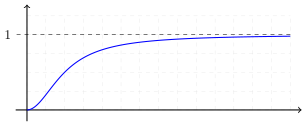
Suppose . Since is surjective, there exists such that and . Since is increasing, we must have . Now, and . Thus, since , we have .
Exercise 4.16
Let , with . By the density of the rational numbers from Lemma 1.49, we know that there exists some with . By the density of the irrational numbers Lemma 1.53, we know that there exists some with . Finally, again by the density of the rational numbers from Lemma 1.49, we know that there exists some with . Observe that:
-
•
with since and . Hence is not nondecreasing on .
-
•
with since and . Hence is not nonincreasing on .
Thus, is not monotone on the interval .
Exercise 4.19
(i) Let . If , then . Consequently, , and so is bounded above by and below by on the set .
(ii) Let . Given any , let satisfy . Then and so is not an upper bound for on . However, since was chosen arbitrarily, it follows that is unbounded on .
Exercise 4.23
For , we have
Let be given and choose . If satisfies , then
Hence, by the - definition, the function is continuous at .
Exercise 4.24
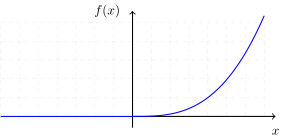
We consider two cases:
-
•
If , then .
-
•
If , then .
In particular, for we have .
Let be given and choose . Suppose satisfies , so that . By our earlier observation,
Thus, by the - definition, is continuous at .
Exercise 4.27
Let . For , we have
where the last step is by the triangle inequality. Now suppose . Then another application of the triangle inequality yields
and so
Let be given and choose
Suppose satisfies . Then and so it follows by our earlier observations that
Thus, by the - definition, is continuous at . Since was chosen arbitrarily, it follows that is continuous.
Exercise 4.28
Let . For we have
Now suppose . Then the triangle inequality yields
and so
Let be given and choose
Suppose satisfies . Then and so it follows by our earlier observations that
Thus, by the - definition, is continuous at .
Exercise 4.29
Here is one suggested interpretation.
| - definition (4.4) | Informal idea |
| There exists some | There exists some distance |
| such that for all | such that no matter how close we are to |
| there exists some with | we can find a point |
| such that . | with and are at least far apart. |
Exercise 4.31
Fix and let be given. Let satisfy , so that and
Hence, by definition, is discontinuous at .
Exercise 4.34
(i) We have already reduced to the case and so and .
The triangle in Figure 4.13(b) has area . On the other hand, the area of the sector in Figure 4.13(a) is . Since the triangle contains the sector, and the result follows.
(ii) By the double angle formula, . Thus, using the inequality , we have
as required.
Exercise 4.38
Let be a rational point, fix and let be given. By the density of the irrationals from Lemma 1.53, there exists some with . In particular,
Thus, by definition, is discontinuous at .
Exercise 4.39
The function is continuous at . Indeed, for , we have
since . On the other hand, clearly also holds when (since both sides are in this case).
Let be given and choose . If , then
Hence, by the - definition of continuity, is continuous at .
Exercise 4.40
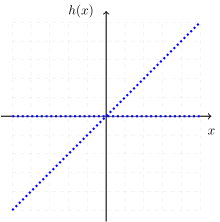
We claim that continuous at and discontinuous at all other points.
To see is continuous at , let be given and choose . If satisfies , then
Hence, by the - definition, is continuous at .
Now let be a rational point; that is, . We shall show is discontinuous at . Indeed, let and be given. By the density of the irrationals from Lemma 1.53, we know that there exists some with . Thus, and
Hence, by definition, is discontinuous at .
Now let be an irrational point. Using a similar argument to that above, we shall show is discontinuous at . Indeed, again let and be given. Define . By the density of the rationals from Lemma 1.49, we know that there exists some with . Thus, and, by the triangle inequality,
Hence, by definition, is discontinuous at .
Exercise 4.46
We know from Lemma 4.32 that for all . Consequently, if , then
Let be given and choose . If , then and it follows from our earlier observations that
Thus, by the - definition, as .
Exercise 4.47
We claim that . To see this, let be given. We break the proof up into two parts.
-
•
Since is continuous by Lemma 4.33 (and, in particular, continuous at the point ), there exists some such that
If we define , then it follows that
-
•
For , we have
If , then it follows from the triangle inequality that
Thus, in this case we have
Now choose . If satisfies , then and it follows from the above observations that
Now set . If satisfies , then it follows from the above that . Hence, by the - definition of a limit, as .
Finally, note that
and so the function is not continuous at by the limit characterisation of continuity from Lemma 4.42.
Exercise 4.48
(i) There are many examples. For instance, let for all . Then we know that , but is unbounded.
(ii) Let be an interval, and and suppose exists. By the definition of a limit with , there exists some such that
Define and suppose . Then, by the triangle inequality,
as required.
Exercise 4.50
Let and .
1. Let be given. Since and as , by the - definition of a limit, there exists some , such that
and
Choose . By the triangle inequality,
Thus, by the - definition of a limit, as .
2. By Exercise 4.48, since as , the function is locally bounded around . More precisely, there exists some and some such that for all satisfying .
Let be given. Since and as , by the - definition of a limit, there exists some , such that
and
Choose . By the triangle inequality,
Thus, by the - definition of a limit, as .
3. We first show that .
Let . Since as and , by the - definition of a limit, there exists some such that
Thus, if satisfies , then it follows by the triangle inequality that
and so
Hence, by the - definition of a limit, as .
Since as and as , we can use the result from part 2 to conclude that as , as required.
Exercise 4.52
Let be an interval and , be continuous. Given , by the characterisation of continuity from Lemma 4.42, we know that
1) By Theorem 4.49 1) and (A.12), we know that
Hence, by Lemma 4.42, it follows that is continuous at .
2) By Theorem 4.49 2) and (A.12), we know that
Hence, by Lemma 4.42, it follows that is continuous at .
3) Suppose for all . By Theorem 4.49 3) and (A.12), we know that
Hence, by Lemma 4.42, it follows that is continuous at .
The above argument shows that , and, under the above additional hypothesis, are all continuous at . Since was chosen arbitrarily, it follows that these functions are continuous.
Exercise 4.54
We know from Lemma 4.33 that the functions and are both continuous. Furthermore, from Example 4.53, we know any polynomial function is continuous. It therefore follows from the limit laws that the functions
are both continuous. Finally, since for all , it again follows by the limit laws that
is continuous.
Exercise 4.58
We know from Lemma 4.33 that is continuous. We also know that for all . Thus, from the limit laws, the function is continuous. Finally, again by Lemma 4.33, we know that is continuous. Hence, the function given by for all is a composition of the continuous functions and , and hence by the composition law (Theorem 4.55), is continuous.
Exercise 4.63
(i) Note that as . We know from (the borrowed!) Lemma 4.35 that the exponential function is continuous. Thus, by the sequential continuity theorem,
(ii) We may write
We know that and as . Thus,
We know from (the borrowed!) Lemma 4.35 that the natural logarithm is continuous. Thus, by the sequential continuity theorem,
Exercise 4.66
For , observe that
Thus, if we assume , then
Let and choose . If , then our earlier observations show that
Hence, by the - definition of a limit, as .
Exercise 4.69
(i) For we may write
Let be given. We know from Lemma 4.67 that there exists:
-
•
Some such that for all ;
-
•
Some such that for all .
Let . Then for all we have
In particular,
Hence, by the - definition of a limit, as .
(ii) Let be given. By Lemma 4.67 we know there exists some such that for all . Consequently,
Hence, by the - definition of a limit, as .
Exercise 4.72
1 2. Suppose 1 holds; that is, exists and satisfies .
Let be given. By definition, there exists some such that for all satisfying , we have . In particular:
-
•
For all satisfying , we have . Thus, by the - definition, .
-
•
For all satisfying , we have . Thus, by the - definition, .
2 1. Suppose 2 holds; that is, and both exist and satisfy
Let be given. By definition, there exists some , such that
-
•
For all satisfying , we have .
-
•
For all satisfying , we have .
Let . Then, by the above, for all satisfying we have . Thus, by the - definition, .
Exercise 4.74
We claim that .
For , observe that
Thus, if we have , then
Let and choose . If , then it follows from our earlier observation that
Hence, by the - definition, .
We claim that .
Let and recall from Lemma 4.33 that is continuous. Hence there exists some such that
On the other hand, observe that for we have
Now let . If , then it follows from our earlier observations that
We can therefore apply (A.13) with to conclude that
Hence, by the - definition, .
From the above, . Hence, by Exercise 4.72, we know that .
Finally, since , we conclude from Lemma 4.42 that is not continuous at .
Exercise 4.77
Here is a suggested interpretation.
| - definition (4.4) | Informal idea |
| For all | Given any threshold |
| there exists some | there exists some small distance |
| such that if satisfies , | such that if the point is within of |
| then . | then lies beyond the threshold . |
Exercise 4.79
(i) For , we have
Given , choose . If satisfies , then and so (A.14) holds and . Hence,
since . Hence, by definition, as .
(ii) We know from Example 4.44 that . Hence, by the - definition of a limit with , there exists some such that
Now, let be given and choose . If , then it follows that
Thus, by definition, as .
Exercise 4.80
(i) For all , there exists some such that if satisfies , then .
(ii) For all , there exists some such that if satisfies , then .
(iii) For all , there exists some such that if satisfies , then .
Exercise 4.81
(i) For all , there exists some such that if , then .
(ii) For all , there exists some such that if , then .
Exercise 4.82
(i) Let be given and choose . If , then . Hence, by definition, .
(ii) Let be given and choose . If , then . Hence, by definition, .
(iii) Let be given and choose . If , then we know from the definition of the exponential function that
Hence, by definition, .
Exercise 4.84
We apply the change of variables to get
Recall from Example 4.44 that . Since as , it follows from the composition law that , as required.
Exercise 4.90
(i) We claim that , and so has an essential discontinuity at .
To see this, let be given and choose . If , then and so
Hence, by definition, .
(ii) We claim that .
Let be given and choose . If , then it follows from Lemma 4.32 that
Hence, by the - definition of a limit, as , and the claim now follows from the equivalence in Exercise 4.72.
Since,
it follows that has a removable discontinuity at .
(iii) We claim that does not exist, so has an essential discontinuity at .
Arguing by contradiction, suppose exists and, in particular, for some .
Choose . By the - definition of a one-sided limit, there exists some such that
Note that there exists some such that where
and
In particular, by the periodicity of the function,
Thus, and . However, by (A.15) we must have
Thus, by the triangle inequality,
a contradiction. Thus, the one-sided limit must fail to exist.
Alternatively, we can argue using a one-sided variant of Lemma 4.59. Assume as above. Since and as and , for all , it is not difficult to show (arguing as in the proof of Lemma 4.59) that we must have
However, we have already shown that and for all . This implies that
which is again a contradiction.
(iv) We claim that and , so has a jump discontinuity at .
For the left-sided limit, for note that
Hence, if , then it follows that and so
Let be given and choose . If , then and it follows from our earlier observations that
Hence, by definition, .
For the right-sided limit, for note that
If , then it follows that
Let be given and choose . If , then and it follows from our earlier observations that
Hence, by definition, .
Alternatively, we can use what we know from earlier examples to study . For instance, we know from Example 4.26 that the function given by for all is continuous. Hence, by Lemma 4.42, we have as and therefore, by Exercise 4.72 we have as . Since agrees with for all , it follows that as . A similar argument shows that as .
Exercise 4.93
(i) Fix and let and , so that . Consider the function given by for all . Then is continuous and and . Thus, by the intermediate value theorem, there exists some such that , as required.
(ii) Fix and let and , so that . Let and consider the function given by for all . Then is continuous and and , by the Bernoulli inequality. Thus, by the intermediate value theorem, there exists some such that , as required.
Exercise 4.96
Consider function given by if and if . Then the image of is the set , which is not an interval.
Exercise 4.98
Let . Our goal is to show there exists some such that .
Since , it follows that there exists some such that for all . Similarly, since , there exists some such that for .
Let and , so that . Then the restriction of to is a continuous function which satisfies and . By the intermediate value theorem, there must exist some such that , as required.
Exercise 4.99
Let , with and consider the closed, bounded interval .
For all , we have , and so is bounded on .
Suppose . For all , we have , and so is bounded on .
Exercise 4.101
Take given by
It is easy to see is unbounded. Note, however, that is not continuous at .
Exercise 4.104
Clearly, and so for all . Thus, is bounded above by .
Given , let satisfy . Then and so . Hence,
Thus, there exists some such that , so that is not a maximum point of . Since this is true for any , it follows that has no maximum point.
Exercise 4.105
We claim that is a maximum point of . Indeed,
On the other hand, the restriction has no maximum point. Indeed, given any , we can find some (for instance, we could choose ). Then
This shows that is not a maximum point of . Since this is true for any , it follows that has no maximum point.
Exercise 4.107
Let be given by
Note that for and for .
We claim is injective. Indeed, suppose for some , .
-
•
If , then if follows from our earlier observation that , and so . This implies .
-
•
On the other hand, if , then , and so . This again implies .
Thus, in either case and so is injective.
Finally, we claim is not monotone. To see this, it suffices to note that:
-
•
and so is not nondecreasing;
-
•
and so is not nonincreasing.
Thus, the function has all the desired properties.
Exercise 4.109
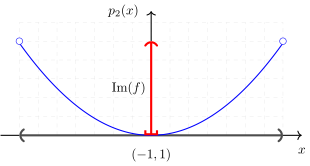
We claim that .
Given , it immediately follows that and so .
On the other hand, since extends to a continuous function on satisfying and , by the intermediate value theorem for every there exists some such that . Hence .
Since we have shown and , it follows that . Note that the image is therefore an interval, but not an open interval. See Figure A.3.