5.7 Properties of the exponential function
At this stage we have developed a rich theory of differentiation, with highlights including the inverse function theorem and the first derivative test. We now apply these tools to study one specific example: the exponential function , introduced in Definition 4.5.
Differential properties of the exponential function
The exponential function has some very special properties and plays a fundamental role in the theory of differentiation. Recall from Lemma 5.12 that is differentiable and satisfies and . Our first goal is to show that is in fact the only function with this property!
Suppose is differentiable and
Then .
The conditions in (5.24) on provide a simple example of a differential equation. In particular, Proposition 5.55 determines which functions satisfy the equation (5.24) involving the derivative (it shows there is only one such function: the exponential). Differential equations are a central topic in both pure and applied mathematics, and are fundamental to mathematical modelling of physical processes (and therefore indispensable to engineering, physics and other sciences). You shall explore the fascinating world of differential equations in detail if you take the year 2 course Modelling and Computing.
To prove the proposition, we first show the following lemma.
The exponential function is non-vanishing: for all .
We discussed this basic property of the exponential in Chapter 4, but only justified it for (where it follows directly from Definition 4.5). We can now use our theory of differentiation to give a satisfying and complete proof.
Consider the function given by for all . By using the product and chain rules, we have
Hence, by the first derivative test, is constant. If we fix , then and so . This implies that . ∎
Using the intermediate value theorem, strengthen the conclusion of Lemma 5.57 by showing that for all .
We now have all the tools we need to prove Proposition 5.55.
By Lemma 5.57, the reciprocal is defined for all . Let
and note that is differentiable by the quotient rule. Moreover,
Hence, by the first derivative test, is constant. Thus, and so for all . ∎
Algebraic properties of the exponential function
Surprisingly, we can use the special differential properties of the exponential function to show that is satisfies a very special algebraic property!
for all , .
Fix and consider the function
One can check that is differentiable, for all and (see Exercise 5.60; remember is fixed here and not a variable).
Thus, by Proposition 5.55, we have for all . Rearranging this identity gives the desired result. ∎
Fill in the details of the proof of Theorem 5.59 by showing is differentiable, for all and .
Irrational exponentiation
Going right back to the beginning of the course, in 0.5 we asked how to make sense of irrational exponents, such as or . The multiplicative identity for the exponential function is key to understanding this problem. Before we get to that, however, we first explore some more direct consequence of Theorem 5.59.
Verify that satisfies the following properties:
-
(i)
for all ;
-
(ii)
for all and ;
-
(iii)
for all and ;
-
(iv)
for all and ;
-
(v)
In particular, for all .
Hint: for (i), recall the proof of Lemma 5.57.
Exercise 5.61 (v) suggests the number plays an important role for the exponential function.
We define .
From Exercise 5.61 (v), we see that for all . However, is defined for all values of (both rational and irrational), so we can use these observations to introduce a notion of irrational exponentiation.
We define for .
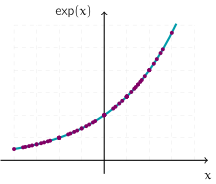
To reiterate: the idea behind Definition 5.63 is that agrees with our usual algebraic notion of an exponential whenever (as expressed by the properties in Exercise 5.61). However, we can use the function to extend the definition of to irrational powers. This idea is intuitive if we plot the values for , as in Figure 5.14. We see that the values for all lie along the graph of , but they leave lots of ‘holes’ at irrational values of . By defining , we fill in the holes.
So far we have only defined irrational exponentiation for the special base . Our next goal is to extend this to all bases: that is, to define for all and all .
Let and . Using the result of Exercise 5.61 (iv), we see that
where we have used the fact that is (by definition) the inverse of . This shows us that the function agrees with the familiar notion of exponentiation whenever . However, the function is defined for all values of (both rational and irrational), so we can use it to extend the definition of exponentiation to irrational powers.
Given and , define .
This finally answers 0.5 of how to define irrational powers!
We can also use this definition to show that the formula for differentiating rational powers (established in Exercise 5.32) can be extended to all real powers, .
Fix . Define by . Prove that is differentiable on and that .