5.2 Continuity and differentiability
Differentiability makes precise the notion of a ‘smooth’ graph. If a function is differentiable, so that its graph is smooth, then it is reasonable to expect that the graph should not have any breaks. In other words, any differentiable function should be continuous. This is indeed the case for all the examples of differentiable functions we saw in Section 5.1 and we now show it is true in general.
Let be an open interval and suppose is differentiable at . Then is continuous at .
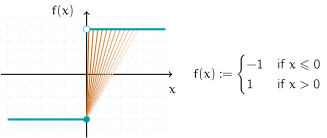
By the contrapositive of Theorem 5.20, if is not continuous, then is not differentiable. We illustrate this in Figure 5.7, which shows the failure of differentiability in the presence of a jump discontinuity.
To prove Theorem 5.20, we introduce the following useful lemma, which is essentially a mild reformulation of the definition of the derivative.
Let be an open interval and be differentiable at . Then
is continuous at and satisfies for all .
Give an interpretation of the definition of from (5.9): in particular, for , what does the value measure? Illustrate your interpretation with a figure.
Since is differentiable at , using the formulation of the definition of the derivative from Remark 5.3, it follows that
Thus, by definition, is continuous at .
Moreover, the equation is satisfied for all . When it reduces to which is trivially true. For the equation is simply a rearranged form of the definition of in that case. ∎
Compare Lemma 5.21 to our discussion of the function from Example 4.44. How are they related?
By Lemma 5.21, there exists a function which is continuous at with and satisfies
By the limit laws, it follows that
Thus, by definition is continuous at . ∎
It is important to note that the converse of Theorem 5.20 does not hold. That is, not every continuous function is differentiable. Indeed, we have already seen multiple examples of continuous functions which fail to be differentiable, such as the function from Example 5.7.