4.4 Limits of functions

The ε\varepsilon-δ\delta definition of continuity bears a very close resemblance to the ε\varepsilon-NN definition of a limit of a sequence. In this section, we develop this connection by introducing limits of functions.

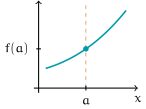
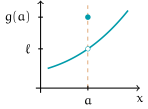
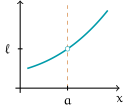
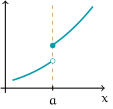
The examples in Figure 4.15 show different behaviours that are possible, and are helpful for building up intuition about limits of functions as xax\to a. In each case, we describe what we would intuitively expect our definition of a limit to satisfy: the functions in (a), (b) and (c) should all converge to \ell as xax\to a, but the function in (d) should not converge as xax\to a.

(a) f(x)f(x) converges to f(a)f(a) as xax\to a
(b) g(x)g(x) converges to \ell as xax\to a
(c) h(x)h(x) converges to \ell as xax\to a
(d) k(x)k(x) does not converge as xax\to a
Figure 4.15: Examples of functions with different behaviours at the point aa.

One curious feature is that Figure 4.15 (b) and (c) suggest that our definition of “the limit of f(x)f(x) as xax\to a” should work whether or not ff is defined at aa: the value of the limit should depend on the behaviour of the function around aa, but not actually at aa. This observation turns out to be important and useful.

With the above examples in mind, we turn to the formal definition.

Definition 4.41 (Limit of a function).

Let II\subseteq\mathbb{R} be an interval and aIa\in I. Let f:Ef\colon E\to\mathbb{R} where either E=IE=I or E=I{a}E=I\setminus\{a\}.

We say f(x)f(x) converges to \ell\in\mathbb{R} as xx tends to aa if for all ε>0\varepsilon>0, there exists some δ>0\delta>0 (which in general depends on ε\varepsilon) such that

if xI satisfies 0<|xa|<δ, then|f(x)|<ε.\text{if $x\in I$ satisfies $0<|x-a|<\delta$, then}\quad|f(x)-\ell|<\varepsilon.

In this case, we write limxaf(x)=\displaystyle\lim_{x\to a}f(x)=\ell or f(x)f(x)\to\ell as xax\to a.

As we shall see, Definition 4.41 turns out to be precisely what is needed to formalise our intuition from Figure 4.15.

We can reinterpret continuity in terms of the notion of a limit of a function. Indeed, for the functions in Figure 4.15, we can see that the only example which is continuous at aa is the first one, where the limit at aa agrees with f(a)f(a). For the functions that are not continuous, either ff is undefined at aa, or the limit at aa does not exist. The following lemma formalises this observation.

Lemma 4.42 (Limit characterisation of continuity).

Let II\subseteq\mathbb{R} be an interval, f:If\colon I\to\mathbb{R} and aIa\in I. Then

f is continuous at aIif and only iflimxaf(x)=f(a).f\text{ is continuous at }a\in I\quad\text{if and only if}\quad\lim_{x\to a}f(% x)=f(a).
Proof.

This is immediate from the definitions of continuity (Definition 4.20) and limits (Definition 4.41). ∎

Example 4.43.

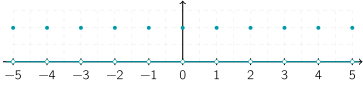
Consider the function χ:\chi_{\mathbb{Z}}\colon\mathbb{R}\to\mathbb{R} given by

(4.7) (4.7) χ(x):={0if x,1if x;\chi_{\mathbb{Z}}(x):=\begin{cases}0&\text{if $x\in\mathbb{R}\setminus\mathbb{% Z}$,}\\ 1&\text{if $x\in\mathbb{Z}$;}\end{cases}

we illustrate the graph of χ\chi_{\mathbb{Z}} in Figure 4.16.

Claim: limx0χ(x)=0\displaystyle\lim_{x\to 0}\chi_{\mathbb{Z}}(x)=0.

Proof.

Let ε>0\varepsilon>0 be given and choose δ:=1\delta:=1. If xx\in\mathbb{R} satisfies 0<|x|<δ0<|x|<\delta, then xx\notin\mathbb{Z} and so χ(x)=0\chi_{\mathbb{Z}}(x)=0. Hence,

|χ(x)0|=|00|=0<ε.|\chi_{\mathbb{Z}}(x)-0|=|0-0|=0<\varepsilon.

Thus, by the ε\varepsilon-δ\delta definition of a limit, limx0χ(x)=0\lim_{x\to 0}\chi_{\mathbb{Z}}(x)=0. ∎

Note that while limx0χ(x)=0\lim_{x\to 0}\chi_{\mathbb{Z}}(x)=0, we have χ(0)=1\chi_{\mathbb{Z}}(0)=1. Since limx0χ(x)χ(0)\lim_{x\to 0}\chi_{\mathbb{Z}}(x)\neq\chi_{\mathbb{Z}}(0), it follows from the limit characterisation of continuity from Lemma 4.42 that χ\chi_{\mathbb{Z}} is discontinuous at 0.

Figure 4.16: The function χ:\chi_{\mathbb{Z}}\colon\mathbb{R}\to\mathbb{R} from Example 4.43 satisfies limx0χ(x)=0\displaystyle\lim_{x\to 0}\chi_{\mathbb{Z}}(x)=0.

The definition of the limit limxaf(x)\lim_{x\to a}f(x) also has the additional flexibility that it does not require ff to be defined at aa. We illustrate why this can be useful in the following example.

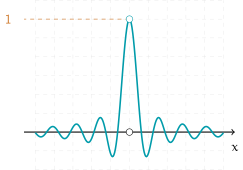
(a) The function sinc\mathrm{sinc}^{*} is defined on {0}\mathbb{R}\setminus\{0\}. There is a conspicuous ‘hole’ in the graph.
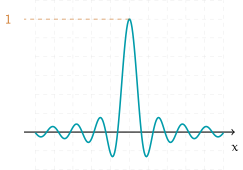
(b) The function sinc\mathrm{sinc} is formed by extending the definition of sinc\mathrm{sinc}^{*} to x=0x=0 by ‘filling in the hole’.
Figure 4.17: The function sinc\mathrm{sinc}^{*} from Example 4.44 and its continuous extension sinc\mathrm{sinc}.
Example 4.44.

Consider the function

sinc:{0};sinc(x):=sinxxfor all x{0};\mathrm{sinc}^{*}\colon\mathbb{R}\setminus\{0\}\to\mathbb{R};\qquad\mathrm{% sinc}^{*}(x):=\frac{\sin x}{x}\qquad\text{for all $x\in\mathbb{R}\setminus\{0% \}$;}

see Figure 4.17. Although we have not defined sinc\mathrm{sinc}^{*} at x=0x=0, we can nevertheless define the limit of sinc\mathrm{sinc}^{*} as x0x\to 0. In particular, we claim that limx0sinc(x)=1\displaystyle\lim_{x\to 0}\mathrm{sinc}^{*}(x)=1.

Proof.

Let x(0,π/2]x\in(0,\pi/2] and recall from Lemma 4.32 that sinxxtanx\sin x\leq x\leq\tan x. Taking reciprocals and multiplying through by sinx>0\sin x>0, we obtain

0cosxsinxx1.0\leq\cos x\leq\frac{\sin x}{x}\leq 1.

This implies that

(4.8) (4.8) |sinxx1||cosx1|.\Big{|}\frac{\sin x}{x}-1\Big{|}\leq|\cos x-1|.

A similar argument shows that (4.8) also holds for x[π/2,0)x\in[-\pi/2,0).

By Lemma 4.33, the function cos\cos is continuous and so given ε>0\varepsilon>0, there exists some δ0>0\delta_{0}>0 such that if |x|<δ0|x|<\delta_{0}, then |cosx1|<ε|\cos x-1|<\varepsilon. Set δ:=min{δ0,π/2}\delta:=\min\{\delta_{0},\pi/2\}. If 0<|x|<δ0<|x|<\delta, then (4.8) implies that

|sinc(x)1|=|sinxx1|<ε.|\mathrm{sinc}^{*}(x)-1|=\Big{|}\frac{\sin x}{x}-1\Big{|}<\varepsilon.

Hence, by the ε\varepsilon-δ\delta definition of a limit, limx0sinc(x)=1\displaystyle\lim_{x\to 0}\mathrm{sinc}^{*}(x)=1. ∎

Example 4.45.

In light of Example 4.44, it makes sense to extend sinc:{0}\mathrm{sinc}^{*}\colon\mathbb{R}\setminus\{0\}\to\mathbb{R} to a function on sinc:\mathrm{sinc}\colon\mathbb{R}\to\mathbb{R} defined on the whole real line and given by

sinc:;sinc(x):={sinxxif x0,1if x=0.\mathrm{sinc}\colon\mathbb{R}\to\mathbb{R};\qquad\mathrm{sinc}(x):=\begin{% cases}\displaystyle\frac{\sin x}{x}&\text{if $x\neq 0$,}\\ 1&\text{if $x=0$.}\end{cases}

Intuitively, we form sinc\mathrm{sinc} by ‘filling the hole’ in the graph of sinc\mathrm{sinc}^{*}. Moreover, by choosing the value sinc(0)=1\mathrm{sinc}(0)=1, we fill in the hole in such a way that sinc:\mathrm{sinc}\colon\mathbb{R}\to\mathbb{R} is continuous: see Figure 4.17.

Exercise 4.46.

Show that limx0cosx1x=0\displaystyle\lim_{x\to 0}\frac{\cos x-1}{x}=0.

Exercise 4.47.

Let f:f\colon\mathbb{R}\to\mathbb{R} be given by

f(x):={sin(πx)if x<1;1066if x=1;x21if x>1.f(x):=\begin{cases}\sin(\pi x)&\text{if $x<1$;}\\ 1066&\text{if $x=1$;}\\ x^{2}-1&\text{if $x>1$.}\end{cases}

Determine whether the limit limx1f(x)\displaystyle\lim_{x\to 1}f(x) exists. If the limit does exist, then compute its value. Is ff continuous at 11?

Exercise 4.48.

Recall that the boundedness test for sequences states that if a limit of a sequence exists, then the sequence is bounded.

  1. (i)

    Show that the analogue of this result does not hold for limits of functions. In particular, find a function f:f\colon\mathbb{R}\to\mathbb{R} such that limxaf(x)\displaystyle\lim_{x\to a}f(x) exists for some aa\in\mathbb{R}, but ff is unbounded.

  2. (ii)

    However, a local version of the boundedness test does hold. Let II\subseteq\mathbb{R} be an interval, aIa\in I and f:I{a}f\colon I\setminus\{a\}\to\mathbb{R} and suppose limxaf(x)\lim_{x\to a}f(x) exists. Show there exists some δ0>0\delta_{0}>0 and M>0M>0 such that

    |f(x)|<Mfor all x(aδ0,a+δ0)I{a}.|f(x)|<M\qquad\text{for all $x\in(a-\delta_{0},a+\delta_{0})\cap I\setminus\{a% \}$.}