A.2 Chapter 2
Exercise 2.5
(i)
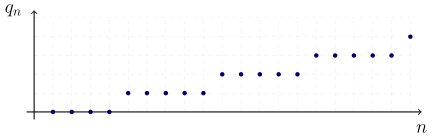
The sequence where is the unique value for which there exists some such that .
(ii)
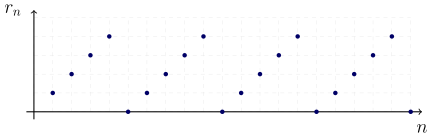
The sequence , where is the unique value for which there exists some such that .
(iii)
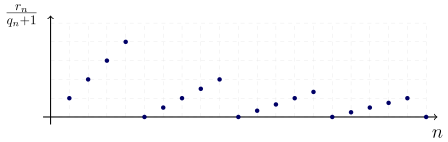
The sequence where and are defined by for all .
Exercise 2.8
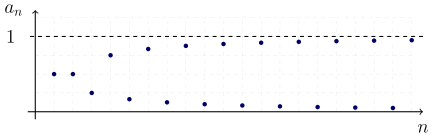
, , , , , , , .
Exercise 2.9
The sequence is defined recursively by ‘saying out loud’ the digits of the previous term. In particular we have
| 1 | is ‘one one’ so the next term is | , |
| 11 | is ‘two ones’ so the next term is | , |
| 21 | is ‘one two, one one’ so the next term is |
and so on. Since is ‘one three, one one, two twos, two ones’, the next term of the sequence is .
Exercise 2.13
| Increasing | Non-decreasing | Decreasing | Non-increasing | Monotone | |
| (i) | |||||
| (ii) | |||||
| (iii) | |||||
| (iv) | |||||
| (v) |
Exercise 2.14
Suppose is a non-increasing sequence. Let so that, by hypothesis and therefore . Since this holds for all , we conclude that is a non-decreasing sequence.
Exercise 2.18
(i) For all , we have
since for . Thus,
and therefore is an upper bound for . Since an upper bound exists, the sequence is bounded above.
(ii) For all , we have
and therefore
Let and choose with . The above inequality shows that and so is not an upper bound for the sequence . Since was chosen arbitrarily, we conclude that this sequence is not bounded above.
Exercise 2.20
Suppose is bounded. Then there exists and such that for all . If we choose , then it follows that
and therefore for all .
Conversely, suppose there exists some such that for all . Taking and , we have for all and so is bounded.
Exercise 2.21
Suppose is bounded below. Then there exists some such that for all . Defining , it follows that for all and so is bounded above.
Exercise 2.28
(i) We claim that as .
For , we have
where in the last step we used the fact that for all .
Let be given and choose . If satisfies , then it follows from our earlier work that
Hence, by the - definition of a limit, as .
(ii) We claim that as .
For , we have
Let be given and choose . If satisfies , then
Hence, by the - definition of a limit, as .
Exercise 2.29
Let be given and choose . Then for all with , we have
Thus, by the - definition of a limit, as .
Exercise 2.31
Given , we may write
On the other hand, given , the Bernoulli inequality tells us that . Combining these observations,
Now let and write for some . Let be given and choose . If satisfies , then
Thus, by the - definition of a limit, as .
Exercise 2.33
It is clear that . For with , we have
Hence, for all .
Let be given. From Exercise 2.31, we know that as and so by the - definition of a limit there exists some such that for all with . Consequently, if satisfies , then
Hence, by the - definition of a limit, as .
Exercise 2.35
For , we have
Let be given and choose . If with , then
Thus, by the - definition of a limit, as .
Exercise 2.36
-
(i)
(a).
-
(ii)
(c).
-
(iii)
(b);
-
(iv)
(b);
-
(v)
(b);
-
(vi)
(d).
The justification is as follows:
(i) (a). This is the - definition of a limit.
(ii) (c). Suppose (ii) holds. Then taking , for all we have for all . However, this can only hold if so that for all . Thus (c) holds.
Conversely, suppose (c) holds so that for all . Then for all we have for all , so (ii) holds.
(iii) (b). Suppose (iii) holds. Taking , there exists some such that for all . Thus, by the triangle inequality, for all . Thus, for all , so (b) holds.
Conversely, suppose (b) holds. Then there exists some such that for all . Let . Then for all . Thus, (iii) holds.
(iv) (b). Suppose (iv) holds, so there exists some and some such that for all . Thus, by the triangle inequality, for all . From this we conclude that
so that (b) holds.
Conversely, suppose (b) holds. Then there exists some such that for all . Let . Then for all . Thus, (iii) holds.
(v) (b). Suppose (v) holds. Taking , there exists some such that for all . Thus, for all , so that (b) holds.
Conversely, suppose (b) holds. Then there exists some such that for all . Let . Then for all . Thus, (v) holds.
(vi) (d). The condition for all holds if and only if , which in turn holds if and only if . Thus, (vi) holds if and only if there exists some such that for all , which is precisely the condition (d).
Exercise 2.40
(i) We claim that as .
Multiplying both the numerator and denominator by gives
Since we know as , it follows from parts 1 and 2 of Theorem 2.38 that
Since the limit of the denominator is non-zero, we can apply part 3 of Theorem 2.38 to conclude that
as required.
(ii) We claim that as .
Exercise 2.41
For , observe that
Since as , we expect to be able to replace the on the denominator with . More precisely, by the - definition of a limit, since there exists some such that
If satisfies , then it follows by the triangle inequality that
and so
Let . Since as and , by the - definition of a limit, there exists some such that
If we define , then
If satisfies , then it follows from our earlier observations that
Hence, by the - definition of a limit, as .
Exercise 2.44
For , we have
We know from Exercise 2.31 that as and, by the limit laws, as . Hence, by the squeeze theorem, as .
Exercise 2.45
Let be a nonempty set which is bounded above, so that exists by the completeness axiom.
(i) Given , using the approximation property for suprema from Lemma 1.31 with , there exists some such that .
(ii) From part (i) we have where and for all . Since and as , it follows from the squeeze theorem that as .
Exercise 2.46
(i) We argue by contradiction. Suppose and are convergent sequences with for all and
Let . Then by the - definition of a limit there exists some such that for all . Similarly, there exists some such that for all . Taking , it follows that and for all . Consequently, for we have
and so
This is a contradiction, so we must have .
(ii) This is false. Indeed, consider the convergent sequences and given by and for all . Then for all but .
Exercise 2.52
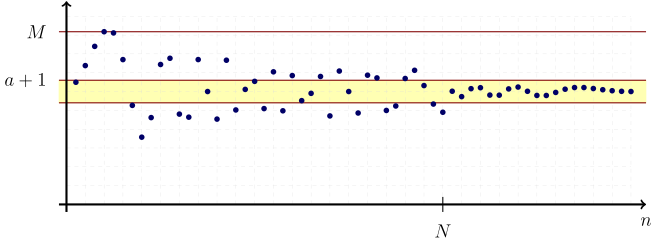
The proof of the boundedness test. If as , then there exists some such that for all . We can then take a maximum of the set of remaining terms to conclude that for all .
Exercise 2.56
(i) For , we have
Let be given and choose . If satisfies , then
Thus, by definition, as .
(ii) From Workshop 3, we know as . Hence, given , taking in the - definition of a limit, there exists some such that for all . Taking reciprocals, it follows that if , then . Thus, by definition, as .
(iii) For , by dividing through by , we have
By Exercise 2.31 and Worksheet 3, we know and as . By the limit laws, as . Hence, given , taking in the - definition of a limit, there exists some such that for all . Taking reciprocals, it follows that if , then . Thus, by definition, as
Exercise 2.57
Let for all . Then is unbounded. Indeed, given , if we choose odd, then it follows that . On the other hand, if we chose even, then . Thus, is neither a lower or an upper bound for . Since was chosen arbitrarily, it follows that is not bounded above or below.
We claim that as . Indeed, if as , then there would exist some such that for all . However, for all , so there can be no such choice of .
Finally, we claim that as . Indeed, if as , then there would exist some such that for all . However, for all , so there can be no such choice of .
Exercise 2.62
Suppose is sequence which converges to a limit and is a subsequence. Let be given. By applying the - definition of a limit to , there exists some such that for all . However, if , then it follows that and so . Thus, by the - definition of a limit, as .
Exercise 2.65
Let for . Then
and
Hence, as and as . In particular, we have found two subsequences with different limits, and so the sequence must diverge by the subsequence test.
Exercise 2.66
We show diverges by the boundedness test. Indeed, let and choose . Then satisfies where and so
Thus, is not an upper bound for . Since was chosen arbitrarily, it follows that is unbounded and therefore diverges by the boundedness test.
We show diverges by the subsequence test. Indeed, for all we have and . Thus, and as . Hence, has two distinct subsequential limits and therefore diverges by the subsequence test.
Finally, we claim as . Indeed, let and choose . If , then arguing as in (A.3) we see that
Recalling that for all , we therefore have
Thus, by the - definition of a limit, as .
Exercise 2.67
(i) Let and . Given , choose , so that . It follows that .
The above argument shows that for all , there exists some such that for all there exists some such that . Hence, by the - definition, diverges.
(ii) Let and . Let satisfy
in other words, if and if . It then follows from the definition that
Furthermore, by the triangle inequality,
and so .
Given , choose even if and odd if , so that . Thus,
The above argument shows that for all , there exists some such that for all there exists some such that . Hence, by the - definition, diverges.
Exercise 2.71
(i) We prove for all by induction on .
Base case: By hypothesis, , which forms the base case of our induction.
Inductive step: Suppose, as an induction hypothesis, that for some . Then using the formula
we see that is formed by multiplying together and summing positive terms and therefore must itself be positive. This closes the induction.
(ii) Let . Using the formula
we expand out the square to give
as required. Since the squared term is always non-negative, we conclude that for all . Thus, since by hypothesis, we have for all .
(iii) From part (i) we know the sequence is bounded below by . We claim is monotone non-increasing. To see this, let and consider
By part (i), we know and by part (ii) we know . Hence the right-hand side of (A.4) is non-negative and so . Thus the sequence is monotone non-increasing.
(iv) By part (iii) and the monotone convergence theorem for sequences, is convergent. Let denote the limit of the sequence. By taking the limit of both sides of the relation
we see that must satisfy
Rearranging this identity, we conclude that , as required.
Exercise 2.72
The sequence is clearly increasing (and therefore monotone) and bounded above by . Thus, by the monotone convergence theorem, as for some .
By the limit laws, we know as , where the sequence is given by . However, we know from Exercise 2.33 that this converges to and so by the uniqueness of limits, .
Exercise 2.73
(i) When the sequence is monotone non-decreasing and bounded above by ; for the sequence is monotone decreasing bounded below by . In either case, by the monotone convergence theorem, the sequence must converge to some limit .
In the case , we know the sequence is bounded below by . Thus, we must have and, in particular, . On the other hand, for we know the sequence is monotone non-decreasing, and so we must have .
(ii) Let for all and consider the squared sequence . By the product law for limits, this sequence must converge to . Now consider the subsequence of even terms , given by
Consequently, the subsequential limit is given by
However, by the subsequence test, the subsequential limit must equal the limit of the parent sequence, and so .
Since , or in other words , we must have either or . However, we showed in part (i) that and so we must have .
Exercise 2.75
If we take the unbounded sequence given by for all , then this has no convergent subsequence. Indeed, given any strictly increasing sequence of natural numbers, we have for all and so is unbounded and therefore diverges by the boundedness test.