A.1 Chapter 1
Exercise 1.4
Let . Observe that whilst . Combining these observations,
and so is an upper bound for . Since an upper bound exists, is bounded above.
Exercise 1.7
Unless every student is at least meters tall (which would be a major statistical anomaly!), (I) should be false. On the other hand, unless every student is under meters tall (which would again be a major statistical anomaly!), (II) should be true.
The negations of (I) and (II) are, respectively:
-
( I)
There exists a student such that the height of student is less than meters.
-
( II)
For all students , the height of student is less than meters.
It is very likely that ( I) holds and ( II) does not hold.
Exercise 1.8
If is an upper bound for , then is also an upper bound for and .
Exercise 1.9
(i) Write . We claim that every is an upper bound for . Indeed, if , then so for all .
On the other hand, we claim that every is not an upper bound for . Indeed, if , then and , so that is not an upper bound for .
The above shows that is precisely the set of upper bounds for .
(ii) Write where and . We claim that every is an upper bound for . Indeed, if , then so for all . Similarly, so for all . Thus, for all , so is an upper bound for .
On the other hand, we claim that every is not an upper bound for . Indeed, if , then and , so that is not an upper bound for .
The above shows that is precisely the set of upper bounds for .
Exercise 1.11
Suppose , are both least upper bounds for . Since is an upper bound for and is a least upper bound for , we must have . By a symmetric argument, we also have . Hence .
Exercise 1.13
(i) We know from Exercise 1.9 (i) that the set of upper bounds for is . Thus, the least upper bound for is ; that is, .
We know from Exercise 1.9 (i) that the set of upper bounds for is . Thus, the least upper bound for is ; that is, .
Exercise 1.18
Let with .
We claim that .
-
1.
Since, by definition, for all , we see that is an upper bound for .
-
2.
Suppose and . Then and so that is not an upper bound for . Thus, any upper bound for must satisfy .
Hence is the least upper bound for ; in other words, .
We claim that . The argument is essentially the same as that used above.
-
1.
Since, by definition, for all , we see that is an upper bound for .
-
2.
Suppose and . Then and so that is not an upper bound for . Thus, any upper bound for must satisfy .
Hence is the least upper bound for ; in other words, .
The sets and are not bounded above, so each of these sets cannot have a supremum. On the other hand, we know from Remark 1.16 that the empty set does not have a supremum.
Exercise 1.20
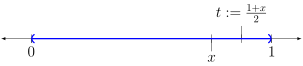
The following sketch illustrates the proof that : for every , the element lies to the right of on the number line.
Exercise 1.21
Let with .
We claim that . To treat all these cases simultaneously, let denote one of the sets , or .
-
1.
Since, by definition, for all , we see that is an upper bound for .
-
2.
Suppose and . If , then and , so that is not an upper bound for . This argument continues to make sense when , provided we just choose to be some number satisfying . On the other hand, if , then the midpoint satisfies . Moreover, and , so that is not an upper bound for . This shows that if is an upper bound for , then .
Hence is the least upper bound for ; in other words, . A minor modification of this argument also shows .
The sets and are not bounded above, so each of these sets cannot have a supremum. On the other hand, we know from Remark 1.16 that the empty set does not have a supremum.
Exercise 1.23
Suppose and are both maxima for . Then and so, since is a maximum (and therefore an upper bound) for , we have . By a symmetric argument, and so we must have .
Exercise 1.25
(i) Let . Since and , and , it follows that is a maximum for ; that is, .
On the other hand, we claim .
-
1.
The above observations show is an upper bound for .
-
2.
If , then and so that is not an upper bound for . Thus, any upper bound for must satisfy .
This shows is the least upper bound for ; that is, .
(ii) Let . Since and for all (and so for all ), it follows that is a maximum for ; that is, .
On the other hand, we claim .
-
1.
The above observations show is an upper bound for .
-
2.
If , then and so that is not an upper bound for . Thus, any upper bound for must satisfy .
This shows is the least upper bound for ; that is, .
Exercise 1.27
(i) Suppose a maximum for exists. Then for all , so that is an upper bound for . Since is the least upper bound for , it follows that .
(ii) Since , it follows that and so . But this contradicts the fact that is a maximum for and therefore satisfies .
Exercise 1.29
Let . We know that and that (since for all ). Hence, by a result of Worksheet 1, we know that does not have a maximum.
Alternatively, if , then for some . However, and . Thus, cannot be a maximum. Since was chosen arbitrarily, this shows no maximum exists.
Exercise 1.30
(i) For , we claim that
-
1.
We may write for all . Hence is an upper bound for .
-
2.
Suppose with , so that . Then there exists some such that and therefore . Moreover, and , so that is not an upper bound for . Here we have used the fact , so that . This shows that if is an upper bound for , then .
Thus, is the least upper bound for ; that is, .
We observed above that for all , and so for all . In particular, . Since does not contain its supremum, it does not have a maximum by a result of Worksheet 1.
Alternatively, if , then for some . However, and . Thus, cannot be a maximum. Since was chosen arbitrarily, this shows no maximum exists.
(ii) For , we claim .
-
1.
Since, by definition, for all , we have for all and so is an upper bound for .
-
2.
Let . If , then and , so is not an upper bound for . On the other hand, suppose , so that . There exists some such that and therefore . Moreover, . Since and , it follows that is not an upper bound for . This shows that if is an upper bound for , then .
Thus, is the least upper bound for ; that is, .
We observed above that for all . In particular, . Since does not contain its supremum, it does not have a maximum by a result of Worksheet 1.
Alternatively, if , then and . If we define , then it follows that and . Thus, and and so cannot be a maximum. Since was chosen arbitrarily, this shows no maximum exists.
Exercise 1.33
We claim that for , .
-
1.
Since for all , it follows that is an upper bound for .
-
2.
Let be given. There exists some such that and therefore . If we define , then and
Thus, for any given we can find such that , which verifies the approximation property.
By Lemma 1.31, we conclude that , as claimed.
Exercise 1.34
1 2. Suppose exists and . Let be given, so that . It follows that cannot be an upper bound for , since is the least upper bound for (by property 2 of Definition 1.10). This mean that there must exist some such that . On the other hand, since is an upper bound for (by property 1 of Definition 1.10), we also have . Combining these observations, , as required.
Exercise 1.35
Consider the set . We claim that .
-
1.
Writing , it follows that for all . Thus, is an upper bound for .
-
2.
We now show satisfies the approximation property from Lemma 1.31.
Let be given. There exists some such that and therefore . If we define , then and
where we used the fact that for . Thus, , which verifies the approximation property.
By Lemma 1.31, we conclude that , as claimed.
Note: In this proof, we chose such that , but here (and often elsewhere) other choices are possible. For instance, we could choose such that and note that for we have
using the fact that to see that .
Exercise 1.37
The additional statements mean the following:
-
(III)
Every pencil is used by at least one student; there are no leftover pencils which go unused.
-
(IV)
There is at least one student who writes with every single pencil.
Note that (I), (II), (III) and (IV) all have different meanings. However, (II) (I), as we already observed, and (IV) (III) (indeed, if one student uses every single pencil, then every single pencil is used by at least one student).
For the negations:
-
( I)
There exists a student such that for all pencils student does not write with pencil .
-
( II)
For all pencils , there exists a student such that student does not write with pencil .
-
( III)
There exists a pencil such that for all students , student does not write with pencil .
-
( IV)
For all students there exists a pencil such that student does not write with pencil .
These statements can be expressed in more everyday language as follows:
-
( I)
There is a student who does not write with any pencil.
-
( II)
No pencil is used by all the students.
-
( III)
There is a pencil no students writes with.
-
( IV)
No student writes with all the pencils.
Exercise 1.38
The additional statements mean the following:
-
(V)
Every pencil is used by every student.
-
(VI)
There is at least one student who writes with at least one pencil.
Note that (I) – (VI) all have different meanings. However, (V) (II) (I) (VI) and (V) (IV) (III) (VI).
For the negations:
-
( V)
There exists a pencil and there exists a student such that student does not write with pencil .
-
( VI)
For all pencil and for all students , student does not write with pencil .
These statements can be expressed in more everyday language as follows:
-
( V)
Not every student writes with every pencil.
-
( VI)
No student writes with any pencil.
Exercise 1.43
(i) If is a minimum for , then so is nonempty. Furthermore, for all and so is a lower bound for . Hence is nonempty and bounded below, so exists. Moreover, since is the greatest lower bound for , it follows that . However, we also have and since is a lower bound for , it follows that . Hence, as required.
(ii) Simply take . Then given any we can form . It follows that and , so that cannot be a minimum for . Since was chosen arbitrarily, this shows no minimum exists.
Exercise 1.45
We have . To bound this below by 2, we need to choose so that
or, equivalently, .
Exercise 1.46
(i) We claim that the set is nonempty and bounded above. To see this, we consider the cases and separately. If , then and so and the set is nonempty. Furthermore, we must have for all (since if , then and so ). Hence, is an upper bound for . On the other hand, if , then so and the set is nonempty. Furthermore, and so must be an upper bound for (since if , then and so ). In either case, we see that is nonempty and bounded above.
Since is nonempty and bounded above, by the completeness axiom exists. In the case , we know and so, since is an upper bound for , we must have . On the other hand, if , then a similar line of reasoning shows . In either case, .
(ii) We claim that : in other words, .
Suppose , so that and we can therefore find some with . Thus,
where the second step is due to the fact that for and the choice of . From (A.1) and the definition of , it follows that for all . However, this contradicts the fact is the least upper bound for , and so .
Suppose , so that and we can therefore find some with . Thus,
where the second step is similar to that in (A.1), this time using for . From (A.2) and the definition of , it follows that and clearly . However, this contradicts the fact is an upper bound for , and so .
We have shown and . It therefore follows that , as claimed.
Exercise 1.48
Clearly and for all , so is nonempty and bounded above. Repeating the argument used in Example 1.44 shows that any least upper bound for must satisfy . However, there is no rational number with this property. Thus, does not have a least upper bound in .
Exercise 1.54
(i) Let and . Choosing , we have . Hence is dense in .
(ii) Let and . If , then choosing , we have . On the other hand, if , then we can choose so that . Hence is dense in .
(iii) Let and . If , then choosing , we have . On the other hand, if , then we can choose . Then and . Hence is dense in .
Exercise 1.55
(i) Let and . If , then and so . Thus, there does not exist any element satisfying , so is not dense in .
(ii) Let and . If , then and so . Thus, there does not exist any element satisfying , so is not dense in .