5.3 Differentiation laws
When studying computational calculus, you will likely have learned useful rules for differentiating sums, products, quotients and compositions of functions. One example is the product rule and another is the chain rule . However, can you explain where these rules come from and why they hold? In this section, we revisit these computational tools and show that they all inexorably follow from the notion of a derivative introduced in Definition 5.2.
Let be an open interval, , be differentiable at .
-
1
Linearity. The function for and are differentiable at , with
-
2
Leibniz/product rule. The function is differentiable at and
-
3
Quotient rule. Provided for all , the function is differentiable at and
We only prove part (b); the remaining parts are left as exercises (see Exercise 5.25 and Worksheet 9).
By Lemma 5.21, there exist functions , that are continuous at with and and satisfy
By substituting the formulæ from (5.10) into and expanding out the resulting product,
where
By the continuity laws from Corollary 4.51, the function is continuous at . It therefore follows that
However, using the definition of from (5.11) and the fact that and , we see that . Combining these observations concludes the proof. ∎
Prove Theorem 5.24 1) by arguing from the definition of the derivative.
Let be a polynomial function, so that there exists some and coefficients , , , such that
By Example 5.11 and the linearity of the derivative, it follows that is differentiable and
The function is differentiable with for all . To see this, we apply the quotient rule to the definition of . Since both and are differentiable and is non-vanishing on , this tells us that is differentiable and
for all , where we have used Example 5.13 and the identity .
Let , be open intervals, be differentiable at and be differentiable at . Then is differentiable at and
By Lemma 5.21, there exists a function which is continuous at with and a function which is continuous at with which satisfy
By applying the formulæ (5.12) to with , we have
where
By the continuity laws, is continuous at . It therefore follows that
However, using the definition of from (5.13) and the fact that and , we see that . Combining these observations concludes the proof. ∎
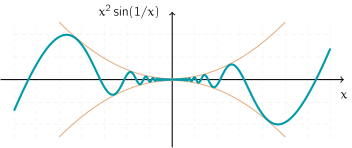
We can use the chain rule and the other laws for differentiation to analyse the following example, which exhibits some interesting behaviour.
Consider function given by
see Figure 5.8. Then is differentiable but its derivative is not continuous.
By the rules for differentiation, the function is differentiable11 1 Strictly speaking, we only defined differentiability for functions defined on an open interval and is not an interval. Here, when we say is differentiable on , we mean that it is differentiable on both of the constituent open intervals and . Similar remarks apply to other domains which can be written as a union of open intervals. on with
It remains to check whether it is differentiable at . The difference quotient is given by
Since , it follows from the squeeze theorem that is indeed differentiable at with
Finally, in light of (5.15), the function is not continuous at . Indeed, similar to Example 4.36, the rapid oscillation of means that does not exist. ∎