4.1 Functions on the real line: definitions and basic examples
Throughout the remainder of the course, we are interested in studying functions (or for some subset ). Here we present many examples of such functions, in order to impress upon the reader their variety.
Some familiar functions
We begin by recalling some familiar functions which you will have seen in your earlier studies and which, indeed, we have already used extensively in previous chapters.
Polynomials.
We say is a polynomial if there exists some and real coefficients , , , such that
A concrete example is the function for all , illustrated in Figure 4.1. Polynomials are particularly simple functions, because they are defined purely using the basic algebraic operations of addition and multiplication.
Rational functions.
Suppose , are two polynomials and is not identically zero. Then we can define and
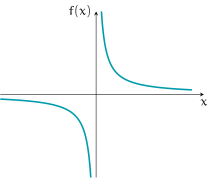
In this case, we call a rational function. As a concrete example, we have the function given by for all . The graph of this function is shown in Figure 4.3.
Trigonometric functions.
The sine function and cosine function are important examples which will feature frequently in our discussion. It is worth recalling the geometric meaning behind these functions.
Take a circle in the plane of radius , centred at the origin. This intersects the -axis at the point and has circumference . Given , starting from we traverse anticlockwise an arc of the circle of length to arrive at : see Figure 4.4. This corresponds to an angle of radians. Then, in - coordinates, the point is given by . We can take this to be the definition of the and : they correspond to coordinates of points on the circle.
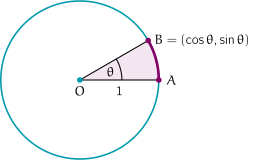
The above describes the definition of and for , but the same works for : we just allow ourselves to potentially loop round the circle multiple times (for we travel round the circle in a clockwise, rather than anticlockwise, direction).
The functions and satisfy the important angle summation formulæ
for all , , to which we shall frequently refer. These formulæ can be proved using trigonometry.
New functions from old
Using the basic building blocks of polynomials, rational functions, trigonometric functions, exponentials and logarithms, we can build many new examples of functions. A simple way to do this is to form sums, differences, products and ratios. For instance, the tangent function is defined as the ratio between and . However, there are many alternative methods for constructing new functions from old.
Piecewise definition.
One way to define new functions is to patch them together using pieces of existing functions. Rather than give a precise definition of this procedure, we simply illustrate it through some concrete examples.
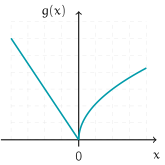
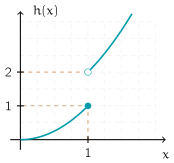
Consider the functions and defined piecewise by
We illustrate the graphs of these functions in Figure 4.5.
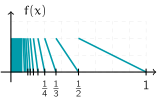
The piecewise-defined functions in Example 4.1 are made up of two pieces. However, there is nothing to stop us using many more pieces if we wish. The following example has infinitely many pieces!
Consider the function given by
This is an example of a piecewise-defined function with infinitely many pieces: we specify the values of on the intervals , , , and so on. We sketch the graph of this function in Figure 4.6(a).
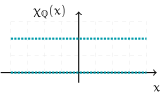
Using piecewise definitions we can construct remarkably complicated and pathological functions.
We define by
Because the rationals and irrationals are both dense subsets of (see Section 1.6), this function is very complicated and it is impossible to accurately plot. Nevertheless, it is common to use a pair of dotted lines to provide a schematic for the graph, as in Figure 4.6(b).
Composition.
Given functions and , we can consider the composition . This can often lead to interesting and useful functions. Here we describe an important explicit example, formed by composing and .
Let be defined by
We sketch the graph of in Figure 4.7. For near , the function oscillates very rapidly.11 1 You can zoom in on an interactive version of this graph online, at https://www.desmos.com/calculator/sbysutrdl3
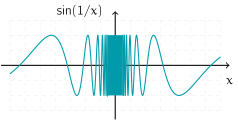
We remark that Example 4.4 is also another example of a piecewise-defined function. Here the piecewise definition was used to get around the fact that is not defined at , allowing us to define on the whole of .
The exponential function
Another method for constructing functions is to use convergent sequences and series. A very important example of this is the exponential function. Given , consider the series . By the ratio test (Theorem 3.32), this series always converges absolutely, and therefore converges, no matter the value of . This observation allows us to make the following definition.
We define by
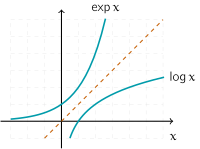
The exponential function is one of the most important functions in all of mathematics. You will likely have encountered it in your earlier courses (although perhaps not defined in the same way) and will be aware it plays an important role in algebra and differentiation. You will also likely be familiar with its graph, as illustrated in Figure 4.8. Later in the course, we shall explore why the various properties of the exponential function hold and why the graph looks the way it does. For now, we record the important properties in the following proposition.
-
1
The image of is (that is, for all ).
-
2
is injective.
-
3
is surjective.
Here we consider only the case of .
- 1.
- 2.
-
3.
We defer a proof until later in the chapter (see Example 4.97).
∎
For , it is less straightforward to determine the behaviour of directly from (4.2). Nevertheless, we shall see that is in fact injective on the the whole real line and for all . We shall ‘borrow’ this result for now, and prove it later in the course.
The natural logarithm
One further method for constructing functions is to take inverses. Here we illustrate this through the example of the natural logarithm.
As discussed above, is both injective and surjective. Since is both injective and surjective, we know from Introduction to Mathematics at University that it is bijective, and therefore we can define its inverse.
We define to be the inverse of the exponential function .
The notation is often used for the natural logarithm, rather than . However, here, and very likely throughout many of your mathematics courses, the notation will always be used to denote the natural logarithm.
As is the inverse of , its graph is formed by reflecting the graph of across the diagonal line , as shown in Figure 4.8.