5.4 The differential inverse function theorem
Suppose is bijective, so that we may define the inverse . The graph of is given by the reflection of the graph of along the diagonal. If is differentiable at , then from the picture in Figure 5.9 we intuitively expect that should be differentiable at . Indeed, the tangent line to at should correspond to the reflection of the tangent line to at . Moreover, reflecting across the diagonal swaps the ‘horizontal change’ and ‘vertical change’ of the lines. Thus, we expect , which can also be written as
Our goal is to make this intuitive argument precise.
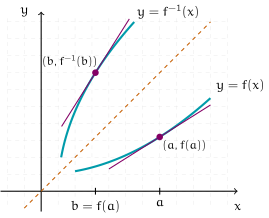
If we know is differentiable at , then we can give a precise proof of (5.16) using the chain rule. Indeed, we can use the chain rule to differentiate both sides of the equation at the point to deduce that . This then rearranges to give (5.16).
The problem with the chain rule argument is that it requires us to know is differentiable at in the first place. The differential inverse function theorem addresses this shortcoming.
Let , be open intervals and be bijective. If and is differentiable at with , then is differentiable at and
The inverse function theorem is a very helpful theoretical and computational tool. It can be used to show that many functions are differentiable and compute their derivatives. Before giving the proof of Theorem 5.30, let’s see some examples of it in action.
Recall from our earlier discussion in Chapter 4 that the exponential function is a bijection.22 2 To be precise, so far we have only rigorously proved that is a bijection when considered as a mapping from to : see Example 4.97. However, we shall extend this in Section 5.7 below. Thus, there exists an inverse function , which satisfies for all and for all . Furthermore, we know from Lemma 5.12 that is differentiable with for all . It therefore follows from the inverse function theorem that is also differentiable and
Let and be the function . Show that is differentiable and
We now turn to the proof of the inverse function theorem.
This proof is nonexaminable.
Fix so that we can write for some . To establish whether is differentiable at , we need to consider the difference quotients
Given such that , we may write for some such that . Thus, the difference quotient can be rewritten as
On the other hand, by applying to both sides of , we see that
By Theorem 4.112, we know that the inverse function is continuous, and so
Combining this observation with (5.17) and using the composition law for limits from Theorem 4.55, we have
where the last step uses the quotient rule for limits of functions from Theorem 4.49. Since , this completes the proof. ∎