4.3 The - definition of continuity
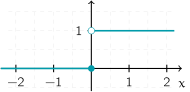
Intuitively, a function is continuous if its graph contains no ‘abrupt jumps’ or ‘breaks’, so that it can be drawn without lifting the pen off the page. Many familiar functions such as polynomials and trigonometric functions are continuous. For contrast, we illustrate two functions which do not have this property in Figure 4.9: in both cases, the graph is ‘broken’ at . Whilst the mechanical ‘without lifting the pen’ idea of continuity is helpful for building intuition, it is not useful for mathematical reasoning. We therefore need to formulate a precise mathematical definition, which encapsulates our intuition.
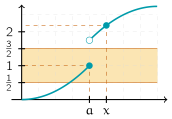
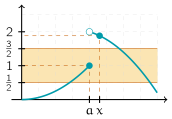
We first need to have a better understanding of what it means for the graph to have an ‘abrupt jump’. Let’s consider the functions illustrated in Figure 4.9. From the picture, we see that each function has a jump at . If we take any point slightly to the right of , then we see from the sketch that but . Thus, even if is really close to , the values of and are far apart: they are separated by at least . Visually, the point lies outside the horizontal corridor of radius , centred around the line .
With the above example in mind, we can start to understand what it means for a function to be continuous at a point . In particular, we need to rule out the behaviour observed in Figure 4.9. Thus, continuity should mean
Another way to express this is:
We can turn (4.3) into a formal mathematical definition in a similar way to how we defined the limit of a sequence. Note that, since we want to consider that are ‘close’ to , we need to be defined on an interval around . For simplicity, the way we will ensure this is by simply requiring that the domain of is an interval.
Let be an interval, and .
-
1
We say is continuous at if for all , there exists some (which in general depends on ) such that
-
2
We say is discontinuous at if it is not continuous at .
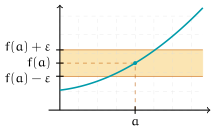
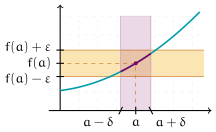
We illustrate the idea behind this definition in Figure 4.10, which shows the graph of a function which is continuous at . Given , in Figure 4.10(a) we consider the horizontal ‘-corridor’ around : that is, all points in the plane with values satisfying . We are free to choose as small as we like, which means we can take the corridor to be as thin as we like. In Figure 4.10(b) we see that, no matter how thin we make the corridor22 2 You may find the applet at https://www.desmos.com/calculator/kycrjq0aqj helpful to see this: it is an interactive version of Figure 4.10(b), where you can use the sliders to vary and and see the effect this has on the shaded regions., it is always possible choose such that the graph of over the interval lies entirely within the corridor. Thus, if , so that , then the point lies in the -corridor, which means precisely that : see Figure 4.11.
We can also compare how the formal definition matches with our intuitive notion of continuity.
| - definition (Definition 4.20) | Informal idea (4.3) |
| For all | For any measure of closeness, |
| if satisfies , | if is near enough to , |
| then . | then is close to . |
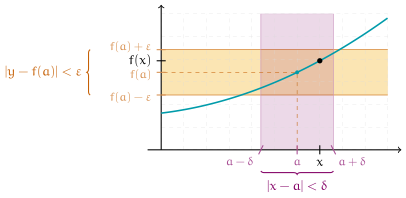
Definition 4.20 is very reminiscent of the - definition of the limit of a sequence. For sequences, the parameter is used to describe ‘terms far enough along the sequence’. Here the parameter plays a similar role: it is used to describe ‘ near enough to ’. For this reason, many of the skills you acquired when working with sequences can be applied to understand continuity of functions.
The function given by for all is continuous at .
For , we have
Suppose . Then, by the triangle inequality,
and so
Let be given and set . If satisfies , then we certainly have and so it follows by our earlier observations that
Thus, by the - definition of continuity, is continuous at . ∎
Let be the function from Example 4.1, which is given by
We sketched the graph of in Figure 4.5, which shows that there is a rough ‘bend’ at . Nevertheless, we shall prove is continuous at .
Let be given and choose . If , then
On the other hand, if , then
Combining these cases, we see that if , then . Hence, by the - definition of continuity, is continuous at . ∎
Consider the linear function given by for all . Show that is continuous at .
Consider the function given by for all and for . Sketch the graph of and show that it is continuous at .
So far we have only talked about continuity at a point. We can also define what it means for the entire function to be continuous.
Let be an interval and . We say is continuous if is continuous at for all . We say is discontinuous if it is not continuous.
The function given by for all is continuous.
Let . For , we have
Suppose . Then, by the triangle inequality,
and so
Let be given and set . If satisfies , then and so it follows by our earlier observations that
Thus, by the - definition of continuity, is continuous at for all , therefore is continuous. ∎
Show that the function given by for all is continuous. Hint: .
Show that the reciprocal function given by is continuous at every point .
It is equally important to be able to show certain functions fail to be continuous. Let be an interval, and . By negating the definition of continuous at , we obtain the following.
| The function is discontinuous at if | |||
| (4.4) | (4.4) | there exists some such that for all , | |
| there exists some with such that . |
Give an informal explanation of what it means for to be discontinuous at and match it to the precise definition in (4.4) by filling in the following table.
| - definition (4.4) | Informal idea |
| There exists some | |
| such that for all | |
| there exists some with | |
| such that . |
Let be the function from Example 4.1, given by
We sketched the graph of in Figure 4.5, which shows that there is a ‘jump’ or ‘break’ in the graph at . Consequently, we expect fails to be continuous at . We prove this is indeed the case. (You may find the applet at https://www.desmos.com/calculator/5lsgjmwbdl helpful to illustrate the proof.)
Let and . It follows that
In particular, given any , if we choose , then it follows that and . Thus, is discontinuous at . ∎
Trigonometric functions
Here we begin an in-depth study of the familiar trigonometric functions such as and . Intuitively, from our knowledge of the graphs of these functions we expect them to be continuous. Our goal is to verify that this is indeed the case.
To achieve this goal, we will rely on certain inequalities for trigonometric functions, which can be proved using geometric arguments. Since these inequalities will also be useful later in the course (and in other courses!), we give them their own lemma.
For all we have
We shall return to prove these results after achieving our goal of establishing the continuity of and .
The functions and are continuous.
Since for all , it suffices to show the result for the sine function only.
Let be given and fix . To establish that is continuous at , we need to choose so that whenever , we have . To make progress, we write and use the angle summation formulæ:
Let . Since , if we ensure then Lemma 4.32 will certainly apply. Thus,
where we have also used the fact that and .
So, choose . From the above observations, it follows that if satisfies , then
Thus, is continuous at by the - definition of continuity. Since our choice of was arbitrary, we conclude that is continuous on . ∎
We now return to prove the borrowed Lemma.
Since and are odd functions and is an even function, it suffices to consider the case . Since the trigonometric functions arise in geometry, our argument is geometric.
We shall prove the inequality and leave the remaining inequalities as exercises (see Exercise 4.34 below).
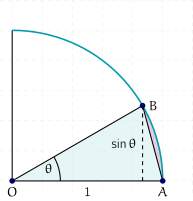
On the one hand, the area of the triangle in Figure 4.13(a) is . On the other hand, the area of the sector is . Since the sector contains the triangle, and the result follows. ∎
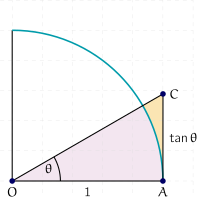
Let . Complete the proof of Lemma 4.32 as follows.
-
(i)
Using Figure 4.13(b), apply a geometric argument to show that .
-
(ii)
Use and the double angle formula to show that .
The exponential and logarithm
We also consider the exponential and natural logarithm functions, introduced in Definition 4.5 and Definition 4.7.
The functions and as continuous.
For now will ‘borrow’ this result and leave the proof until later. At the end of this chapter, we shall see that continuity of implies continuity of . In the next chapter, we shall show is continuous, and therefore complete the proof.
Further examples
Here we present some more ‘exotic’ examples which really push the boundaries of our intuition.
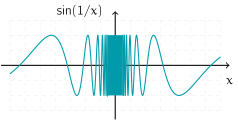
The following example demonstrates a new kind of behaviour which results in a discontinuity: oscillation.
Let be defined by
We recall the graph of in Figure 4.14(a). Recall that, for close to , the function will oscillate very rapidly. In particular, there will be infinitely many ‘peaks’ where . Using this observation, we can show is not continuous at .
Choose . For any , there exists some such that where
In particular, by the periodicity of the function,
Thus, and . Since was chosen arbitrarily, this shows that is not continuous at . ∎
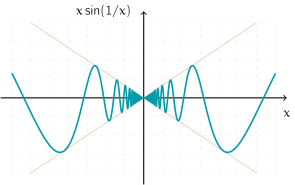
The next example demonstrates even more extreme oscillatory behaviour.
Fix . We will consider the case where is irrational; the remaining case is left as an exercise (see Exercise 4.38).
Choose . For any , by the density of the rationals (see Section 1.6), there exists some such that . In this case, . Since was chosen arbitrarily, this shows that is not continuous at . ∎
Let be the function from Example 4.37 and be a rational point. Show that is discontinuous at .
Let be defined by
Give a rough sketch of the graph of this function. For which values of is continuous at ?