4.10 The continuous inverse function theorem
To conclude the chapter, we consider inverses of continuous functions. We shall prove the inverse function theorem, which allows us to deduce information about the inverse of a continuous function .
Continuity and injectivity
In order to define its inverse, we need a function to be injective. A simple example of an injective function is a function which is either increasing or decreasing (in other words, it is strictly monotone). However, there are examples of functions which are injective but are not strictly monotone.
Find an injective function which is not strictly monotone.
The trick to Exercise 4.107 is to consider functions which have a jump or break in the graph. That is, your solution should be discontinuous. Indeed, if is both injective and continuous, then it is intuitively clear that this forces to be either increasing or decreasing. We make these ideas precise using the intermediate value theorem, leading to the following result.
Let be an interval and be a continuous, injective function. Then is strictly monotone.
By the result of Exercise 4.107, we see that Proposition 4.108 may fail if we do not assume is continuous.
We may assume that contains at least two points, otherwise the claim is trivial. Let , with . Since is injective, this implies that either or . We assume ; the remaining case can be treated similarly or by reflection (replacing with ).
We argue by contradiction, assuming that is not strictly monotone on . This means there must exist some such that
In the first case, the intermediate value theorem implies that there is such that . In the second case, the same argument gives some such that . Since and , in either case this contradicts the injectivity of . Hence is strictly monotone. ∎
Recall from Corollary 4.95 that continuous functions map intervals to intervals. If we start with an open interval, however, then the image may not be open.
Consider the continuous function given by . Show that the image is an interval, but not an open interval. Draw a figure to illustrate this.
However, if we work with injective continuous functions, then we can use Proposition 4.108 to show that the open property is preserved.
Let be an open interval and be continuous and injective. Then the image is an open interval.
By the result of Exercise 4.109, we see that Corollary 4.110 may fail if we do not assume is injective.
To prove Corollary 4.110 we shall use a simple characterisation of open intervals.
Let be an interval. Then the following are equivalent:
-
1
is an open interval.
-
2
For all , there exists some such that .
-
3
For all , there exists some , with such that , .
Roughly speaking, property 2 tells us that for any point , we can move slightly to the left or slightly to the right of and still stay within . Property 3 is closely related and says that does not have any maximum or minimum.
for Let , with .
-
1. 2.
Consider the case . Let so that . It follows that and and so . Here corresponds to the shortest distance from to one of the endpoints of . Observe that
and so . This shows satisfies 2.
If , , or , then similar (but easier) arguments show that again satisfies 2. This shows that all open intervals satisfy 2.
-
2. 3.
Let and assume 2 holds, so there exists some such that . If we define and , then it follows that and , , so , as required.
-
3. 1.
We prove the contrapositive. If , or , then taking it is clear that there does not exist any such that . If or , then taking it is clear that there does not exist any such that . This shows that whenever is not open, property 3 fails.
∎
We know from Corollary 4.95 that is an interval, so it remains to show that is an open interval.
By Proposition 4.108 we know that is strictly monotone. We shall assume that is increasing; the case where is decreasing can be treated similarly or by reflection.
Let so that for some . Since is an open interval, by Lemma 4.111 there exist , with such that , .
We now consider the points , . Since is increasing, . However, this means satisfies condition 3 of Lemma 4.111 and so it must be an open interval, as required. ∎
The continuous inverse function theorem
Let , be intervals and be a bijective function. The graph of the inverse function is obtained by reflecting the graph of across the diagonal : see Figure 4.28. Suppose is continuous. Intuitively, the graph of has no breaks, and reflecting the graph should not result in new breaks appearing. Thus, we expect that should also be continuous. The following theorem confirms that this is indeed the case.
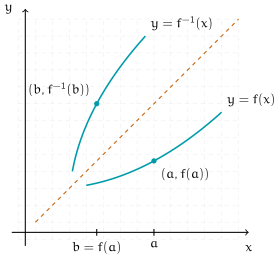
Let , be intervals and be a continuous, bijective function. Then the inverse is continuous.
We shall only show the result when is an open interval. The same arguments can be used to prove the general case, but there are additional technicalities when dealing with endpoints.
Fix and let be given. Our goal is to find some such that
By the surjectivity of there exists some such that . Since is an open interval, by Lemma 4.111 there exists some such that . Thus, if we define , then and . Since is bijective, it is injective. Since is both continuous and injective, by Corollary 4.110, it maps the open interval to an open interval containing .
Since is an open interval and , by Lemma 4.111 there exists some such that . We claim that (4.21) holds for this choice of .
Proving the claim is just a matter of unpacking the definitions. Suppose satisfies . Then and so , using the fact that is the inverse to . Thus,
as required. ∎
We can use the continuous inverse function theorem to show that many familiar functions are continuous.
Given , let be the function . Then is continuous. Indeed, is the inverse of the bijective polynomial map given by . By Example 4.53, we know is continuous, and therefore is continuous by the continuous inverse function theorem.
Whilst it is possible to argue directly from the definition to show the functions from Example 4.113 are continuous, this is quite an involved and messy exercise. It is much easier to let the continuous inverse function theorem do the work for us!
Since we know from Lemma 4.33 that and are both continuous, it follows from the continuous inverse function theorem that the inverse trigonometric functions and are both continuous.
Suppose we know that is continuous. We can then apply the continuous inverse function theorem to deduce that is continuous. Thus, in order to prove the ‘borrowed’ Lemma 4.35, we only need to show is continuous. We shall establish this fact in the next chapter.