Chapter 4 Continuity
Goals.
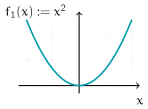
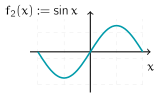
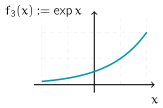
So far, we have developed a deep understanding of the real numbers , which makes precise the idea of a continuous number line. For the second half of the course, we shall study functions . You already have a lot of valuable experience of drawing graphs of such functions: for instance, in Figure 4.1 we recall some familiar examples. These graphs look like nice, smooth curves; it is helpful to think of them as stretched versions of our number line. Our goal is adapt the tools and ideas we developed to study in order to study such curves.
We stress from the outset that there is a huge variety of functions . Those graphed in Figure 4.1, for instance, are important, but they are very special and idealised examples. In general, the graph of some can be very messy: it can have a lot of ‘breaks’ or ‘jumps’, or it can oscillate wildly. We illustrate examples of this kind of behaviour in Figure 4.2. However, even the graphs in Figure 4.2 are somewhat idealised. Indeed, many graphs are so incredibly complicated that it is impossible to accurately draw them: we shall see an example of this below when we introduce the Dirichlet function.
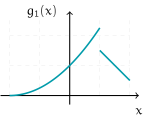
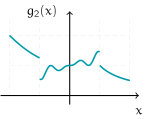
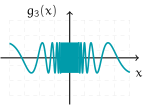
If we compare the graphs of the functions in Figure 4.1 with the graphs in Figure 4.2, there are clear qualitative differences. For instance, on the one hand, the graphs of , and in Figure 4.1 are all unbroken curves, which (loosely speaking) can be drawn without taking the pen off the paper. On the other hand, the graph of in Figure 4.2 has a large ‘jump’ or ‘break’. The central theme of this section is to understand such qualitative distinctions in precise mathematical terms. This will lead us to define continuous functions. The function is an example of a continuous function, whereas is not.
Recall that the most important property of the real numbers is the completeness axiom, which makes precise the idea that there are no ‘gaps’ or ‘holes’ in our number line. Completeness is very closely related to continuity: loosely speaking, there is an analogy between ‘gaps’ or ‘holes’ in and ‘jumps’ or ‘breaks’ in the graph of a function. We shall therefore see a lot the technology we developed in the first half of the course redeployed in the study of continuity.
Learning outcomes.
-
•
Explain key quantified statements such as the definition of a continuous function and the limit of a function, in both intuitive and formal mathematical terms. Apply and illustrate definitions through worked examples.
-
•
Apply theory (such as the limit laws, composition law and continuous inverse function theorem) to deduce whether a given function is continuous.
-
•
Use the theory of continuous functions to prove results about sequences and series.
-
•
Explain the proofs of key results such as the intermediate value theorem, boundedness theorem and extreme value theorem.
-
•
Use abstract - arguments and/or results from class (such as the intermediate value theorem) to prove new statements about continuous functions.
-
•
Create examples to illustrate different possible behaviours of functions.