Chapter 5 Differentiability
Goals.
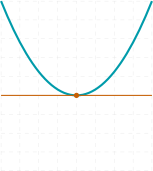
In the previous chapter we studied continuous functions. Recall that, intuitively, these are functions which have an unbroken graph. Despite this, the graph of a continuous function can still look ‘rough’. We illustrate what we mean by this in Figure 5.1: there, the graph of has a sharp angle, the graph of has a bend and the graph of has a cusp. These behaviours are all examples of what we intuitively think of as ‘rough’. On the other hand, if a graph does not have any breaks, angles, bends or cusps, as is the case for the parabola in Figure 5.2(a), then we think of it as ‘smooth’.
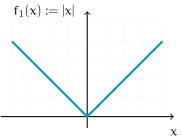
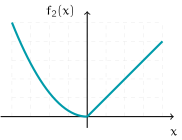
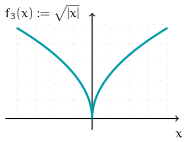
The goal of this section is to develop precise mathematical tools in order to better understand our intuitive notions of ‘rough’ and ‘smooth’. Once we have these tools, we shall go on to use them to study special properties of smooth functions.
It turns out that the distinguishing feature of a smooth graph is that it is possible to draw a tangent line to the graph at every point. Intuitively, a tangent line is a line which ‘just touches’ the graph, in such a way that the graph ‘rests’ on the line. This description is vague, but we shall see how to make the idea precise below. For now, it is helpful to have in mind a picture of tangent lines as in Figure 5.2(a).
By contrast, if the graph is rough with, for instance, a bend, then it is not possible to draw a unique tangent line at the bend. Indeed, in Figure 5.2(b), we see that no matter which choice of line we take, either the left-hand side, the right-hand side or both sides of the graph fail to ‘rest’ on the line.
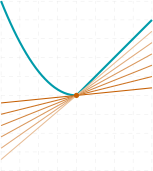
You should already be familiar with differentiation and the idea that the derivative of a function tells you information about the tangent lines to the graph. In this section, we shall revisit and build upon these ideas by introducing the key concept of a differentiable function. This makes precise the idea of a tangent line to a graph and provides a rigorous mathematical description of what it means to be ‘rough’ or ‘smooth’.
You probably have a lot of experience of computational differentiation from your earlier studies. Here we are interested in going under the hood and understanding how and why differentiation works. This theoretical understanding of differentiation will complement, and reinforce, your existing computational skills.
Learning outcomes.
-
•
Explain the definition of a differentiable function and the derivative of a function in both intuitive and formal mathematical terms. Illustrate these definitions through worked examples.
-
•
Apply differentiation theorems such as the product rule, chain rule and differential inverse function theorem to compute derivatives.
-
•
Explain the statement of the mean value theorem and Taylor’s theorem and use these results to prove results involving differentiable functions.
-
•
Interpret the derivative using tools such as the first and second derivative test in order to study basic properties of functions and to solve simple differential equations.