4.8 Classifying discontinuities
Throughout what follows, we let be an interval, and . Assume is not an endpoint of . We can use one-sided limits and the idea of tending to infinity to classify different kinds of discontinuity which can occur at . First of all, we observe the following lemma, which is a direct consequence of the result of Exercise 4.72.
The following are equivalent:
-
1
is continuous at ;
-
2
The left limit and right limit both exist and satisfy
The second characterisation of continuity in Lemma 4.85 can fail in three different ways. We use this to classify discontinuities according to three different types: removable, jump and essential discontinuities.
Removable discontinuities.
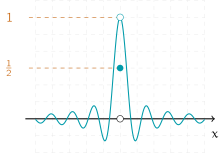
To illustrate this concept, we return to the function first introduced in Example 4.44. In Example 4.45 we extended the definition of to in such a way that the resulting function is continuous. However, we could extend the definition of in another way, for instance defining
However, this function is not continuous at the origin, since the choice of value does not ‘fill in the hole’ in the graph: see Figure 4.21. This is an example of a removable discontinuity.
We say has a removable discontinuity at if exists but
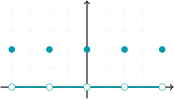
This situation is exemplified both by the function in (4.14) and the function from Example 4.43: see Figure 4.21 and Figure 4.22(a).
Another way to express the definition of a removable discontinuity is that the left limit and right limit both exist and are equal, but their common value does not equal . For instance, in the case of in (4.14), both limits are but .
Removable discontinuities are called ‘removable’ because we can make them go away by redefining the function at . For instance, if we take the function from (4.14) and redefine the value of to be instead of , then we go back to the function from Example 4.45, which we know is continuous.
Jump discontinuities.
These are what we typically think of when we imagine a discontinuity.
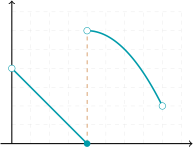
We say has a jump discontinuity at if and both exist but
This situation is exemplified by the function in Example 4.73: see Figure 4.22(b).
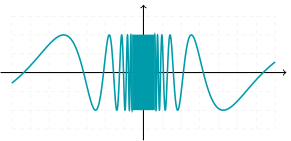
Essential discontinuities.
Finally, we consider the most extreme form of discontinuity, where one or both of the one-sided limits fails to exist.
We say has a essential discontinuity at if or fail to exist as real numbers.
Note that the definition of essential discontinuity includes the cases where or .
Essential discontinuities can themselves be divided into two subcategories.
-
•
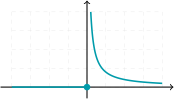
We have a vertical asymptote. This situation is exemplified by the function in Figure 4.22(c). Here : the right-hand limit does not exist as a real number, but we can still give it meaning as using our earlier definitions.
-
•
In the remaining situation, at least one of the one-sided limits fails to exist because the function oscillates wildly near . This situation is exemplified by the function in Example 4.36: see Figure 4.22(d). We provide further details below.
Let be the function from Example 4.36, which was defined by
We claim that has an essential discontinuity at . To see this, we show that does not exist.
Arguing by contradiction, suppose that exists. We can therefore apply Lemma 4.59 (we actually need a slight variant of Lemma 4.59 for one-sided limits, but the idea is the same), which says that if is a sequence of real numbers satisfying as , it follows that .
Let for all , noting as . We have for all . Consequently,
On the other hand, let for all , noting as . This time we have for all . Consequently,
These two observations imply , a contradiction.
Determine whether the following functions have a removable, jump or essential discontinuity at the specified value of .
-
(i)
;
-
(ii)
;
-
(iii)
;
-
(iv)
.