4.9 Continuous functions: three big theorems
Let , with so that is a closed, bounded interval. Here we study continuous functions and show that they have a number of special properties. These properties are described by three big theorems:
-
•
Intermediate value theorem;
-
•
Boundedness theorem;
-
•
Extreme value theorem.
The intermediate value theorem
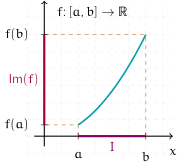
Let , with and suppose is continuous and satisfies . As illustrated in Figure 4.23, we can think of the graph of as a continuous path starting at and ending at . Now chose some ‘intermediate value’ along the -axis. We draw the horizontal straight line , which separates the points and . It is intuitively clear that the path traced out by the graph of must cross the line at some point. That is, there must exist some such that . This simple intuition is made precise by the intermediate value theorem.
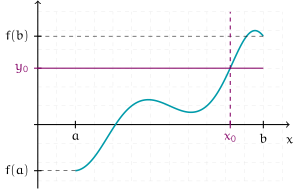
Let , with and suppose is continuous with . For all such that , there exists some such that .
From the sketch in Figure 4.23, the idea behind the intermediate value theorem is intuitively clear. However, it is in fact a deep result which relies on the completeness axiom. To see this is the case, the following example shows how the theorem implies the existence of numbers such as which are missing from (recall from Chapter 1 that the existence of these numbers relies on the completeness axiom).
We can use the intermediate value theorem to give another proof of the existence of . Consider the function given by for all . Then is continuous and satisfies . Hence, by the intermediate value theorem, we see that there exists some such that . In other words, so that .
Use the intermediate value theorem to show the following.
-
(i)
For all there exists some such that .
-
(ii)
More generally, for all and all there exists some such that .
In order to prove Theorem 4.91, we shall make use of the following simple lemma, which exploits the continuity hypothesis.
Let be an interval, be continuous at and .
-
(a)
If , then there exists some such that for all with , we have .
-
(b)
If , then there exists some such that for all with , we have .
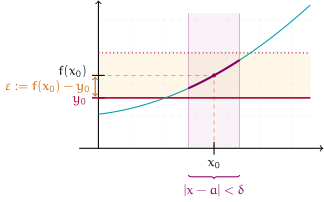
We shall only prove part (a); part (b) follows either by a similar argument or by reflection (replacing with ).
Since , we have
Applying the - definition of continuity with this value of , there exists some such that for all with we have
Observe that
Therefore, for all with , we have
as required. ∎
We may assume , since otherwise we can take to be either or .
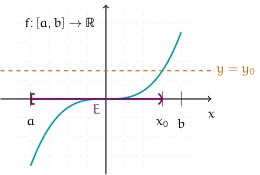
Since we assumed , it follows that and so is nonempty. On the other hand, for all so that is an upper bound for the set . Hence, is nonempty and bounded above, so exists by the completeness axiom and .
Intuitively, it should be clear that and so is the point we are looking for: see Figure 4.25. In order to prove this is the case, we use a Goldilocks approach: we show (not too hot) and (not too cold), and thereby conclude (just right).
Arguing by contradiction, suppose . By Lemma 4.94 (a), there exists some such that for all with . On the other hand, since is the supremum of , there exists some such that (see Lemma 1.31). Since , we have . However, and so we must have . This is a contradiction. Therefore, we must have . Note, in particular, this tells us that , since .
Now suppose . By Lemma 4.94 (b), there exists some such that for all with . Since , it follows that there exists some satisfying : see Figure 4.26.
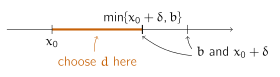
Since , it follows that so that . However, , which contradicts the fact that is the supremum of . Therefore, we must have .
Since we have shown and , it follows that , as required. ∎
We have already seen that the intermediate value theorem gives us a quick and easy way to define radicals such as . However, it has many other important uses. We give one further application here and explore many more applications in Worksheet 8.
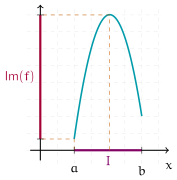
Let be an interval and be continuous. Then the image is an interval.
We illustrate Corollary 4.95 in Figure 4.27 . This is another manifestation of the idea that the graphs of continuous functions do not have any ‘breaks’ or ‘jumps’.
To prove Corollary 4.95 we shall use a simple characterisation of intervals. In particular, the following are equivalent:
-
1.
is an interval;
-
2.
If such that for some , then .
Condition 2 says that any point sandwiched in between two points , belonging to also belongs to . This characterisation should be intuitive and can be proved by considering the supremum and infimum of , treating the cases where is bounded or unbounded above or below separately.
Pick , with and let , By the intermediate value theorem, there exists some such that . Hence . It therefore follows from the above characterisation that is an interval. ∎
Show that there exists a function such that the image is not an interval. Thus, the hypothesis that is continuous is necessary in Corollary 4.95.
Consider the restriction of the exponential function to the non-negative real line.
Recall (from Proposition 4.6) that it is immediate from the formula (4.2) that is increasing on and for all . Thus, is an injective function on .
We claim is also a surjective function. We know from Exercise 4.82 (iii) that and so given any there exists some such that . Since is continuous, by the intermediate value theorem there exists some such that . This shows is surjective, as claimed.
As mentioned earlier, these results continue to hold for defined on the entire real line, but we shall postpone the proof until the next chapter.
Let be continuous and satisfy and . Show that is surjective.
The boundedness theorem
There are many examples of unbounded continuous functions: for instance, is unbounded on . This example is clearly related to the fact that is an unbounded domain. Another kind of example is , which is continuous and unbounded on the bounded domain .
Intuitively, the unboundedness of occurs because the open interval has a ‘hole’ at , which allows the function to escape off to infinity. If we consider a continuous function on a closed, bounded interval , then there are no such means for the function to escape to infinity.
Observe that is bounded on any closed, bounded interval and is bounded on any closed, bounded interval .
From the above, we might begin to expect that any continuous function is bounded. The following theorem shows this is indeed the case.
Let , with . If is continuous then is bounded.
As we have already observed, in Theorem 4.100 it is important to consider continuous functions defined in a closed bounded interval . Indeed, the functions and show that the result can fail for continuous functions defined over other kinds of intervals.
Show that the conclusion of Theorem 4.100 can also fail if is not continuous. In particular, find an example of an unbounded discontinuous function .
To prove Theorem 4.100, our first step is to establish the following ‘local’ version.33 3 We essentially already saw this in Exercise 4.48.
Let be an interval and be continuous at . Then there exists some such that is bounded on .
Since is continuous at , by taking in the - definition of continuity, we see that there exists some such that
Let . Then, by the triangle inequality, we see that
Thus, is bounded on , as required. ∎
Armed with Lemma 4.102, we now turn to the proof of Theorem 4.100. The argument also relies on the least upper bound axiom. This should perhaps not come as a surprise: we have already noted that boundedness of continuous functions is related to the presence or lack of ‘holes’ in the domain.
Let
Our goal is to show that . Indeed, this means precisely that is bounded on the whole interval , which is what we want to show.
Note that so that is nonempty and that is bounded above by . Thus, by the completeness axiom, exists.
Claim: and .
Once we have the claim, then we are done since this shows .
Since , the function is defined at and, moreover is continuous at that point. By Lemma 4.102, there exists some such that is bounded on . In particular, there exists some such that
On the other hand, by the approximation property of the supremum, there exists some such that . In particular, since , we know that is bounded on and so there exists some such that
Combining (4.16) and (4.17), for we see that
It immediately follows from (4.18) that is bounded on and so . This establishes the first part of the claim.
It remains to show . We already know that and so it suffices to show .
We argue by contradiction, assuming . Under this assumption, we can find some such that . By (4.18), the function is bounded on and so . However, so this contradicts the fact that the supremum is an upper bound for . Hence, we must have as claimed. ∎
The extreme value theorem
By Theorem 4.100, any continuous function is automatically bounded. Our goal is now to prove an upgrade of this theorem, by showing attains both a maximum and minimum value.
Let and .
-
1
We say is a maximum point for if for all ;
-
2
We say is a minimum point for if for all .
If a function has a maximum (respectively, minimum) point, then it is bounded above (respectively, below). However, the converse of this statement is not true.
Recall the function given by for all from Exercise 4.11. Show that is bounded above by but has no maximum point.
Often, whether or not a function has a maximum or a minimum point depends on the domain of the function. For instance, if we let and consider the restriction of the function in Exercise 4.104 to the interval , then has maximum points at and .
Show that the function given by for all has a maximum point, but the restriction has no maximum point.
The contrasting behaviour of the functions in Exercise 4.105, which only differ in whether their domain is a closed interval or an open interval, hints at another special behaviour of continuous functions on closed, bounded intervals.
Let , with and be continuous. Then there exist , such that
In particular, has a minimum point and a maximum point on .
Theorem 4.106 is an upgrade of Theorem 4.100: not only does (4.19) imply that is bounded, but it also tells us that attains its (least upper and greatest lower) bounds.
In Theorem 4.106 it is important to consider continuous functions defined on a closed, bounded interval . Indeed, Exercise 4.105 shows that a bounded, continuous function on the bounded interval can fail to have a maximum point – so the “closed” assumption is essential. Likewise, Exercise 4.104 shows that a bounded, continuous function on an unbounded interval can fail to have a maximum point – so the “bounded” assumption is also essential. Hence, we need both the closed and the bounded hypothesis to ensure the conclusion holds.
We show the existence of a maximum point. The existence of a minimum point can be shown in a similar manner, or can be derived from the existence of a maximum point using a reflection argument (replacing with ).
Since is continuous, by Theorem 4.100 it is bounded. In particular, the image
is nonempty and bounded above. Hence, by the completeness axiom exists.
We claim that there exists some such that . Once this is established, it follows that for all , since is an upper bound for .
It remains to prove the claim. We argue by contradiction, assuming that there does not exist any such that . In this case, the function
satisfies for all . Thus, by Corollary 4.51, the function is well-defined and continuous. By the boundedness theorem applied to , there exists some such that for all and so
However, since is the supremum of , by taking in the approximation property, there must exist some such that . In particular, for some and rearranging gives , which contradicts (4.20). Consequently, there must exist some such that , as required. ∎