3.4 Convergence results for series with non-negative terms
We focus here on series with non-negative terms. This simplifies the situation significantly, since the sequence of partial sums is non-decreasing. This gives us access to useful tools such as the monotone converge theorem.
The boundedness and comparison tests
We begin by converting the monotone convergence theorem into the language of series.
Suppose is a non-negative sequence. Then converges if and only if the sequence of partial sums is bounded.
In other words, given a sequence with for all , the boundedness test for series says that the following are equivalent:
-
1.
converges;
-
2.
There exists such that for all .
If converges, then by definition the sequence of partial sums is convergent and hence bounded by the boundedness test for sequences from Lemma 2.49.
Conversely, assume that is bounded. Since the terms are non-negative, the sequence is monotone; in particular, for all . By the monotone convergence theorem, the sequence must therefore be convergent as it is monotone and bounded. ∎
The boundedness test (which, at heart, is just a restatement of the monotone convergence theorem for sequences) will form the backbone of all our convergence results for series with non-negative terms. However, it will take some ingenuity to find different ways in which to apply it. We first observe the following simple corollary, which helps us relate convergence properties of different series.
Let and satisfy for all .
-
1
If converges, then converges.
-
2
If diverges, then diverges.
We shall only prove part 1 since part 2 is an equivalent form of part 1 (it is the contrapositive).
Suppose and satisfy the hypotheses of part 1 of the corollary. Since converges, by the boundedness test from Lemma 3.26 the sequence of partial sums of this series is bounded. In particular, there exists some such that
where we have also used the hypothesis that for all . Since for all , we therefore see that
which means that the sequence of partial sums of the series is also bounded. We may therefore apply the boundedness test from Lemma 3.26 once again (this time using the reverse implication) to conclude that converges. ∎
Give a direct proof of part 2 of Corollary 3.27, using an argument similar to that used for part 1.
The series converges.
Since , we have
Recall from Example 3.14 that is a convergent telescoping series and so, by the limit laws, converges. Thus, converges by the comparison test. ∎
Using the comparison test, determine whether the following series converge or diverge.
-
(i)
;
-
(ii)
;
-
(iii)
.
Hint: for (ii), note that it is enough to consider the tail . What can you say about for ?
We can use the comparison test to prove a converse to Theorem 3.10, showing that any sequence of decimal digits describes a real number.
Let be a sequence with for all . Show that converges to some number in . Conclude that .
The ratio test
There are a number of inventive ways the comparison test can be applied to derive new convergence tests. Here we consider the ratio test, which follows by combining the comparison test with the facts we know about geometric series.
Let be a positive sequence and suppose the sequence of consecutive ratios converges with .
-
1
If , then converges;
-
2
If , then diverges.
The series converges.
If we set for all then is a positive sequence and
Since the limit , the ratio test implies that converges. ∎
The ratio test says nothing about the case . For both from Example 3.29 and from Example 3.6, the limit of the ratios is ; however, the former series converges whilst the latter series diverges. Thus, the ratio test is inconclusive in the case.
We shall only prove part 1; the proof of part 2 is left as an exercise (see Exercise 3.35 below).
Let for all so that, by hypothesis, . Let . By the - definition of a limit, there exists such that for all . Thus, by the triangle inequality,
For any with , we may write
Applying (3.5) to each of the factors for , we deduce that
Since , we know from Example 3.4 that is a convergent geometric series. In light of (3.6), the series converges by the comparison test. Finally, since we have shown a tail converges, we conclude that the whole series converges. ∎
In this exercise we complete the proof of and slightly extend Theorem 3.32.
-
(i)
Prove part 2 of the ratio test, using an argument similar to that used for part 1.
-
(ii)
Adapt the argument used in part (i) to prove the following. Let be a positive sequence and suppose as (see Definition 2.53). Then diverges.
Use the ratio test to determine whether the following series converge or diverge.
-
(i)
;
-
(ii)
;
-
(iii)
;
-
(iv)
.
Divergence of the harmonic series
We now consider the interesting example of the harmonic series . This example is so important that we give it its own theorem!
The harmonic series diverges.
As with Example 3.16 above, Theorem 3.37 provides an example of a series whose terms converge to zero, but which nevertheless diverges. However, the divergence of the harmonic series is a much more subtle affair. There are many different proofs of this result; here we opt for a neat trick based on grouping together terms of similar magnitude. We shall go on to further explore this idea below, and use it to develop a new convergence test.
Let denote the sequence of partial sums of , so that
Our goal is to show that is divergent. By the boundedness test from Lemma 3.26, it is enough to show that is unbounded.
Consider the subsequence . For each , we isolate the term in the sum and partition the remaining terms into ‘blocks’ that each end on a term whose denominator is a power of 2:
Note that there are precisely blocks (ending on denominators ). Since the sequence is decreasing, each term in a given block is bounded below by the last term in that block. From this, we see that
where we bound each block below by the number of terms multiplied by the value of the smallest term within the block. In particular,
where we have used the fact that the lower bound for each block always equals and that there are precisely blocks in the sum. Thus, the subsequence is unbounded, and therefore the parent sequence is also unbounded. ∎
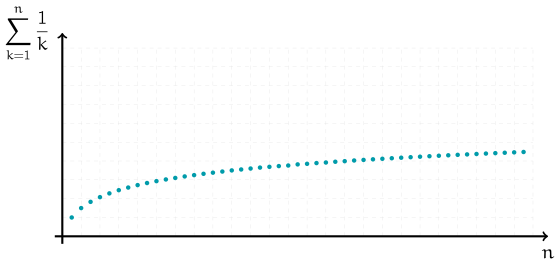
| 1 | 2 | 3 | 4 | 5 | 6 | 7 | 8 | 9 | 10 | 11 | 12 | |
| 1 | 1.5 | 1.83 | 2.08 | 2.28 | 2.45 | 2.59 | 2.72 | 2.83 | 2.93 | 3.02 | 3.10 |
The partial sums of of the harmonic series are unbounded, but they grow very slowly. As shown in the table in Figure 3.2, we only surpass after summing terms. If you were to extend the table further, you would find that we only surpass after summing
this is more than million, trillion, trillion, trillion terms!
The condensation test and -series
The ideas used to prove the divergence of the harmonic series in Theorem 3.37 can be developed into a general test.
Let be a non-increasing, non-negative sequence. Then the following are equivalent:
-
1
The series converges;
-
2
The series converges.
We refer to as the condensed series.
We can revisit the harmonic series from Theorem 3.37 in light of Theorem 3.38. Here the sequence of terms is non-increasing and non-negative, so we may apply the condensation test. The condensed series is which clearly diverges (see Example 3.6). Thus, by the condensation test, we again see diverges. A further example is given by the following.
The series diverges, where denotes the base logarithm.
Since the sequence of terms is non-increasing and non-negative, we can apply the condensation test. The condensed series is the harmonic series , which we know diverges. Thus, by the condensation test, diverges. ∎
We can interpret Example 3.39 as a two-fold application of the condensation test: we first condense to the harmonic series and then condense the harmonic series to .
We show 1 2; the reverse implication is left as an exercise (see Exercise 3.40 below). Let
so that and are sequences of partial sums of the series and , respectively. As with the proof of the divergence of the harmonic series in Theorem 3.37, we consider the subsequence and partition the terms of into ‘blocks’
Since is non-increasing, we have
and therefore
Replacing with in the above and rearranging,
If converges, then the sequence of partial sums is bounded. By (3.7), the sequence of partial sums is therefore also bounded. Consequently, converges by the boundedness test from Lemma 3.26. ∎
Complete the proof of Theorem 3.38 by showing 2 1. Hint: this time, partition
Determine whether the following series converge or diverge.
-
(i)
;
-
(ii)
.
For , the series converges if and only if .
If then the sequence of terms is either unbounded (if ) or all the terms are equal to (if ). In either case, the sequence does not converge to and therefore the series diverges by the th term test from Lemma 3.18.
Now suppose . In this case, the sequence is non-increasing and non-negative, so we may apply the condensation test. The condensed series is . Observe that
By Example 3.4, the geometric series converges if and only if , which is equivalent to . Thus, by the condensation test, converges if and only if . ∎
The series converges.
We shall prove this by combining the comparison and -series tests. We use the bound on from Example 2.34 to obtain
We apply the -series test with to deduce that converges. Thus, converges by the comparison test.33 3 There are two perhaps more obvious comparisons, namely (3.9) (3.9) However, in the context of the comparison test, both lead to inconclusive results as the series formed from the terms on the right are divergent. Can you explain why, intuitively, (3.8) is more efficient than either of the inequalities in (3.9)? ∎
Determine whether the following series converge.
-
(i)
;
-
(ii)
.