Fundamental questions
Familiar number systems.
Growing up, we learn about increasingly advanced systems of numbers:
-
•
The natural numbers (and );
-
•
The integers ;
-
•
The rationals .
These systems of numbers are introduced to analyse increasingly advanced mathematical problems: we use to count apples (and to admit the sad possibility of there being no apples); we use to express that Jemima owes Tim and, finally, if we want to divide a cake amongst 5 friends, then comes to our aid. In particular, as we pass from to to we are free to perform more and more arithmetic operations. In we can only add and multiply; within we are free to perform all four arithmetic operations , , and (provided we avoid dividing by ).
As useful as it is to be able to count apples and divide cakes, the system of rational numbers is insufficient for analysing many other simple mathematical problems.
Consider a right-angled triangle where the right-angle is formed by two sides of length . By Pythogoras’ theorem, the length of the hypotenuse should satisfy . However, as you learned in IMU, it has been known since antiquity that there is no rational number satisfying this property.
There is no rational number equal to the ratio between the circumference of a circle and its diameter.
Consider the natural logarithm . Then there is no rational number satisfying .
The above examples express the fact that the famous constants , and are not rational numbers. But if they are not rational, then what are they?
In order to answer this question, we need to introduce a new system of numbers which is rich enough to allow us to define, amongst many other things, , and . This is the system of real numbers .
Real numbers.
You encountered real numbers in IMU as infinite decimal expansions. Some famous examples are
But what do these expressions really mean? Do you know how a method to compute the digits of or by hand? How do we make sense of addition and multiplication of infinite decimal expansions? For example, let’s ask the seemingly simple question:
What is ?
To perform long multiplication of integers, we start from the right:
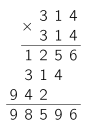
However, for an infinite decimal expansion there is no right! So how do we make sense of ?
Matters are even more mysterious when we consider operations such as irrational exponentiation. We know how to make sense of for by repeated multiplication, and for and by taking reciprocals and roots. However, using our imagination we can ask:
What is ?
Does this expression make sense? My calculator seems to think so: if I plug it in, then I get something like , but where do these digits come from and what do they mean? How could I compute it by hand? How does relate to our existing notations of exponentials ?
The number line.
Underlying all of the above are yet deeper question about what real numbers actually are.
As explored in IMU, it is often useful to think about number systems geometrically in terms of the number line. That is, using the order on , we represent the rational numbers as points on a line with lying to the left of if . If we only think about integers in this way, then our number line has many large holes. When we consider , the points on our number line become a lot more dense, but there are still lots of holes: for instance, there are holes where we expect , and to be.
Geometrically, is the system of numbers we obtain once we ‘fill in all the holes’ in the number line formed from . Thus, if we think of geometrically, then our real number line is a continuum: a continuous, unbroken line.
In principle, the idea of a continuous number line is very appealing, but taken on its own it doesn’t seem very precise or give any indication of how to work with real numbers in practice.
How do we make sense of a continuous, unbroken number line?
This is a difficult question. Whilst it had been known since antiquity that is not rational, it was only in the late 19th century, more than 2000 years later, that mathematicians began to understand what real numbers and the continuum actually are.