5.10 Recap and reflection
In this chapter we introduced the concept of a differentiable function and the derivative. These ideas make precise the idea of a function with a ‘smooth’ graph.
We verified many familiar functions (such as polynomials, the exponential function and trigonometric functions) are all differentiable and derived their derivatives from the definition. Many of these formulæ were already familiar from our experience of computational differentiation, but now we have a much deeper theoretical understanding of why they hold. Similarly, we gave complete proofs of the basic laws for differentiating functions, such as as the product and chain rule, and also the inverse function theorem for differentiable functions.
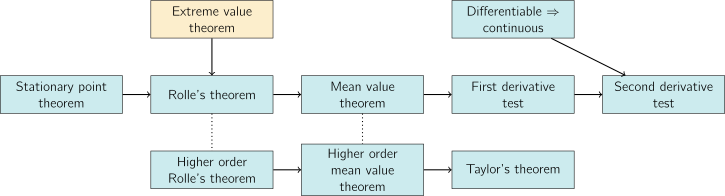
We saw that the derivative tells us a lot of information about the original function . The key tool in this regard was the mean value theorem. This is a very important result, which can be interpreted in many different ways. As an application of the mean value theorem, we proved the first and second derivative tests, which directly relate the behaviour of to the behaviour of . We illustrate the relationship between these core theorems in Figure 5.18.
We applied our theory of differentiation to study the exponential function, one of the most important functions in mathematics. We saw that the exponential function is the unique solution to a differential equation. Using this, we derived the multiplicative identity, which allowed us to make sense of irrational exponentiation.
Finally, we introduced Taylor’s theorem, which allows us to approximate certain functions by polynomials, with good control of the error in the approximation. This can be used to compute values of functions (such as ) to a large number of decimal places. We discussed how Taylor’s theorem is a generalisation of the mean value theorem.