2.2 Sequences of real numbers
Intuitively, a sequence is an ordered list of real numbers , where for all . A more precise way to describe this is through the language of functions.
A (real) sequence is a function .
Given , recall that the value of a function at is usually written as . However, sequences are almost always written using the subscript notation , where is referred to as the th term of the sequence. The full sequence is then expressed using the notation .
Some standard examples of sequences are , , . If we write out the terms explicitly, we see that
-
•
-
•
,
-
•
.
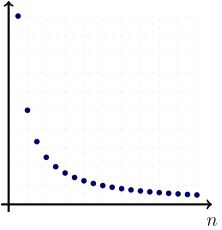
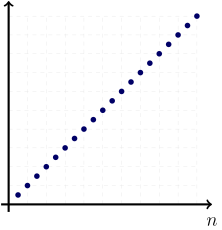
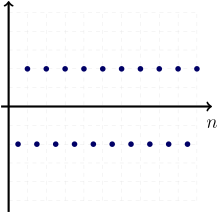
Since a sequence is just a function, one way to visualise it is by drawing its graph. We illustrate the sequences from Example 2.2 in Figure 2.1. As we shall see in the next subsection, the graphical representation of a sequence can help us to understand some of its properties.
We can also consider the sequence from our earlier discussion of decimal expansions. If we denote this sequence by , can we write a neat formula for a general term ? If we set , we can express the remaining terms by either of the following formulæ:
For the sequence arising from the decimal expansion of , it is harder to write down some kind of formula for the terms of the sequence. Nevertheless, by developing our theoretical tools, we shall still be able to say a lot about this sequence.
We emphasise that the sequence is not the same as the set , since the latter does not encode the ordering of the terms. Moreover, corresponds to the image of interpreted as a function.
If we let for all , then the sequence is an infinite ordered list alternating between and . The set just consists of the two possible values of the terms of the sequence.
Another way to visualise is to simply plot each point in the real number line. Here it is helpful to label the points in the plot , , , and so on, so that the ordering is apparent in the diagram: see Figure 2.2.



This kind of plot is especially useful if the terms of the sequence are distinct, as in the case for or . If many terms of the sequence coincide, as is the case for , then this kind of plot tends to obscure some of the information.
From elementary arithmetic, we know for each , there exists a unique and such that (in particular, is the remainder when we divide by ). Sketch the graphs of the following sequences:
-
(i)
;
-
(ii)
;
-
(iii)
Sketch the graph of the sequence where if is even and if is odd.
Another way to describe a sequence is to use a recursive definition. For this, we define the initial terms of the sequence and then describe a law for determining the th term of the sequence from earlier terms.
Here are some simple examples of recursively defined sequences.
-
1.
The factorial sequence can be defined recursively by setting
-
2.
The Fibonacci sequence is defined recursively by setting
Compute the first terms of the Fibonacci sequence.
The first few terms of the look and say sequence are given by
Why is this called the look and say sequence? What is the value of the next term?
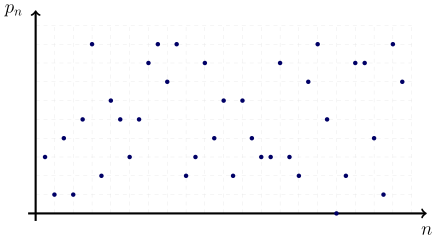
Hopefully the above examples start to give you a sense of the huge variety of sequences out there. We emphasise, in particular, that a sequence does not need to be described by a compact, algebraic formula. Correspondingly, the graph of a sequence does not need to look neat and orderly such as those in Figure 2.1. In Figure 2.3 we plot the sequence where is the th decimal digit of . The graph looks messy and disordered, but it is still a perfectly valid sequence.