2.8 Subsequences and the Bolzano–Weierstrass theorem
Even though the sequence does not converge, we observed that it does have convergent subsequences, such as the subsequence consisting of all even terms. The following theorem is a vast generalisation of this observation.
Every bounded sequence of real numbers has a convergent subsequence.
This is a powerful result, because it allows us to deduce the existence of convergent subsequences without having to explicitly find them. For instance, since for all , the sequence is bounded. We can therefore deduce from the Bolzano–Weierstass theorem that has a convergent subsequence. Finding an explicit convergent subsequence is not so easy, however!
Show that the condition that the sequence is bounded is necessary to guarantee the conclusion of Theorem 2.74. More precisely, find an example of an unbounded sequence which has no convergent subsequence.
Here we give a proof which is a nice application of the monotone convergence theorem. We shall need the following preliminary lemma.
Every sequence has a monotone subsequence.
We postpone the proof of Lemma 2.76 and first show how it can be used to prove Theorem 2.74.
Let be a bounded sequence, so that there exists some such that for all . By Lemma 2.76, there must exist a monotone subsequence . Furthermore, for all , so that is also bounded. Thus, by the monotone convergence theorem, the subsequence converges, as required. ∎
We now turn to the details of Lemma 2.76. A useful thought experiment is to try to construct a sequence for which the lemma fails: that is, try to find a sequence which has no monotone subsequence. After some effort, you should become reasonably convinced that no such sequence can exist, but it is more challenging to turn this intuition into a formal proof.
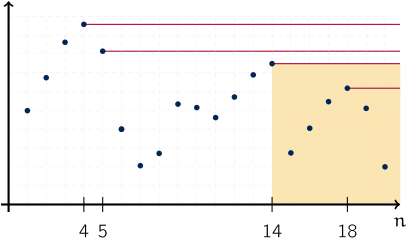
We shall say is a peak if for all with ; we illustrate this concept in Figure 2.9. The proof splits into two cases, depending on the number of peaks.
Case 1: Suppose there exist infinitely many peaks. Then we can find an increasing sequence of natural numbers such that is a peak for all . By definition of a peak, and so the subsequence is non-increasing and therefore monotonic.
Case 2: Suppose there exist finitely many peaks. Then we can find some such that for every peak . In particular, is not a peak and so there must exist some with such that . However, is also not a peak, so there must exist some with such that . Continuing in this way, we construct an increasing sequence of natural numbers such that . Thus, the subsequence is increasing and therefore monotonic. ∎