2.3 Sequences of real numbers: basic properties
Sequences can behave in surprisingly different ways, but some have properties that we will be able to use to analyse their behaviour. We begin by looking at monotone and bounded sequences.
Monotone sequences
We first consider sequences whose terms grow ever larger, or ever smaller.
Let be a sequence.
-
1
We say is increasing if for all ;
-
2
We say is decreasing if for all .
In other words, is increasing if and is decreasing if .
For the sequences from Example 2.2, it is clear that
-
•
is decreasing,
-
•
is increasing and
-
•
is neither increasing nor decreasing.
Sometimes we say strictly increasing or strictly decreasing, to emphasise that the inequalities in Definition 2.10 are strict (as opposed to or ). We also have terms for the non-strict version:
Let be a sequence.
-
1
We say is non-decreasing if for all ;
-
2
We say is non-increasing if for all ;
-
3
We say is monotone if it is either non-decreasing or non-increasing.
Note that any increasing (respectively, decreasing) sequence is automatically non-decreasing (respectively, non-increasing) and therefore monotone. More succinctly,
| Increasing | Non-decreasing |
|
||
| Monotone. | ||||
| Decreasing | Non-increasing |
|
Determine whether the following sequences are increasing, non-decreasing, decreasing, non-increasing or monotone.
-
(i)
.
-
(ii)
;
-
(iii)
;
-
(iv)
;
-
(v)
;
Complete each cell of the table with a or to record your answers.
| Increasing | Non-decreasing | Decreasing | Non-increasing | Monotone | |
| (i) | |||||
| (ii) | |||||
| (iii) | |||||
| (iv) | |||||
| (v) |
Suppose is a non-increasing sequence. Show that is a non-decreasing sequence.
Bounded and unbounded sequences
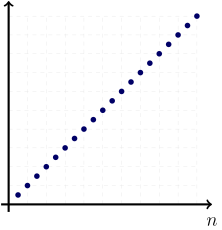
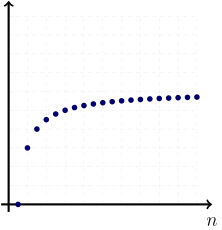
The sequences and are both increasing. However, we can see from their graphs (shown in Figure 2.4) that they exhibit very different behaviours: the first sequence increases without bound, while the second sequence never exceeds 1.
Let be a sequence.
-
1
We say is bounded above if there exists some such that for all ;
-
2
We say is bounded below if there exists some such that for all ;
-
3
We say is bounded if it is both bounded above and bounded below. Otherwise, we say is unbounded.
Note that, by definition, the sequence is bounded above if and only if the set is bounded above in the sense introduced in Definition 1.1.
Consider the three sequences from Example 2.2.
-
1.
Since for all , the sequence is bounded. Similarly, the increasing sequence is also bounded.
-
2.
Since for all , the sequence is bounded below. However, given any , we can find some such that . This tells us that is not bounded above and is therefore unbounded.
-
3.
Since for all the sequence is bounded.
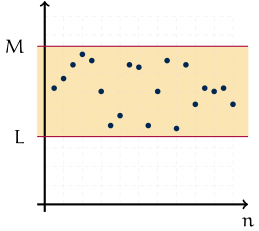
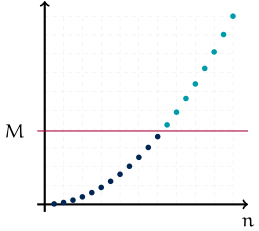
We can interpret Definition 2.15 in terms of our visual aids. For instance, a sequence is bounded above if and only if there exists some such that the graph of the sequence lies entirely below the horizontal line . See Figure 2.5.
Determine whether the following sequences are bounded above
-
(i)
;
-
(ii)
.
A video walk-through of a solution to part (i) can be found here.
Consider the sequence . Using the binomial theorem we see that
This is a particular instance of the Bernoulli inequality from IMU (see also Worksheet 1). Given any , we can find some such that . Thus, . This tells us that is not bounded above and is therefore unbounded.
Show that a sequence is bounded if and only if there exists some such that for all .
Suppose is bounded below. Show that is bounded above.