2.4 Convergence: the - definition of a limit
Earlier, we considered the sequence coming from the decimal expansion of and informally observed that the terms get ‘closer and closer’ to . Our goal here is to make the idea of ‘closer and closer’ precise. To do this, we introduce the concept of a limit. This turns to one of the most important definitions not only in this course, but in the whole mathematics degree!
Before giving the formal definition of a limit, let’s try to motivate some of the key ideas by considering another (simpler) example. Recall the graph of the terms of the sequence from Figure 2.1, which is also reproduced in Figure 2.6. The graph has a horizontal asymptote around the line , which reflects the fact that the terms get closer and closer to as gets large. Intuitively, we’d like to say the limit of the sequence is , but what do we really mean by this?
Let’s try to be a bit more concrete. After the th term, we will always have , so the terms are then within of the limit . After the th term we will always have , so the terms are then within of the limit . In fact, if we prescribe any measure of ‘closeness’ (which could be , , or even ), then after the -term,22 2 Here denotes the ceiling function; in other words, it is the number formed by rounding up to the nearest integer. we will have : see Figure 2.6. Thus,
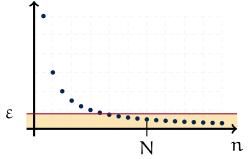
The purpose of the - definition of a limit is to make the informal idea (2.1) precise.
-
1
A sequence is said to converge to a real number if for all there exists some (which in general depends on ) such that
(2.2) (2.2) -
2
We write as to denote that converges to . The number is called the limit of the sequence and is often written as .
-
3
We say a sequence converges if there exists some such that converges to .
-
4
A sequence that does not converge is said to diverge.
The symbol appearing in ‘’ and ‘’ is merely part of the notation! In particular, here we do not define ‘’ to be a number or any other mathematical object: it is just a symbol used to articulate the concept. Since is not a number, it does not make sense to manipulate it algebraically, so in this course you should never write or try to work with expressions such as , or .
This is a subtle definition, which takes work to master. One source of difficulty is the number of quantifiers: we have three! As always, the order in which the quantifiers appear is very important: we explore this in detail in Exercise 2.36 below.
Let’s compare the rigorous definition from Definition 2.23 with our informal idea of a limit from (2.1). As hinted earlier, plays the role of the ‘measure of closeness’. The parameter plays the role of ‘eventually’ (that is, we only consider terms after some specified threshold). Finally, tells us how close the term is from the target limit .
| Informal idea (2.1) | - definition (Definition 2.23) |
| For any measure of closeness, | For all |
| the sequence is eventually | there exists some |
| close to the value of the limit. | such that for all with . |
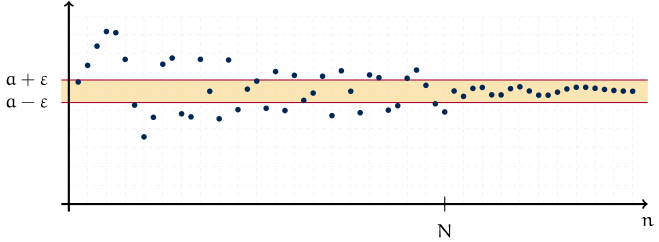
We can also interpret Definition 2.23 in terms of our visual aids. Intuitively, the sequence converges to as if all the points on the graph eventually lie in a thin corridor around : see Figure 2.7. We can make the corridor as thin as we like, provided we consider terms far enough along the sequence.
To get to grips with these definitions, we begin by very slowly walking through a simple example.
Consider the sequence which was informally discussed in Example 2.22. We expect that as , but how do we prove as working from the - definition?
Walk through. Before presenting the formal proof, we’ll walk through the thought processes involved. For this, we slowly and carefully consider the definition, one quantifier at a time. The first quantifier in Definition 2.23 is for all . We therefore begin by fixing some arbitrary to work with (that is, we prescribe a measure of closeness). A typical way to start a proof is:
Let be given.
Now we have fixed , we move on to the next quantifier. We want to show there exists some such that (2.2) holds with and . This is typically where we need to do the real work, but here most of what we need was already discussed in Example 2.22. Let’s begin by writing out (2.2) explicitly for our choice of sequence and target limit. In particular, , and so (2.2) becomes
In other words, we want to find sufficiently large such that all terms beyond the th term are tiny: they are smaller than the prescribed . How can we do this? Well, if we take , then whenever we have , so this choice would work. One small issue is that Definition 2.23 asks that should be a natural number, and there is no guarantee that the choice has this property.33 3 The condition that is a natural number is not an essential part of the definition but more a matter of convention. However, it is a commonly used convention, so we shall stick with it. However, this is easily remedied by taking , as we did in Example 2.22.
Now we’ve worked out what our choice of should be, we can write the next line of the proof:
Choose .
The next step is to verify that this choice of works, in the sense that the desired condition (2.2) holds for this choice. However, we chose precisely with this property in mind, so we can move swiftly on to the next line of the proof:
If with , then .
Finally, it’s helpful to conclude our proof with a wrap up of what we’ve shown:
Thus, by the - definition of a limit, as .
This concludes our walk through of this example. Now we can put the pieces together to come up with our formal proof.
Proof.Let be given and choose . If with , then
Thus, by the - definition of a limit, as . ∎
In the above example, given , it is a straightforward matter to find a suitable choice of to verify the - definition of a limit. This was because we had , which led us to see that was a good choice. However, in most cases, finding a suitable choice of is more challenging: typically, one needs to do some work at the start of the proof to find a suitable bound for in terms of . The following example shows this in action.
We claim that as .
For large values of , the term on the denominator is much, much smaller than the term . Therefore, intuitively, is relatively close to for large values of and, since , we expect as . We shall make this intuition precise using the - definition.
For , note that
Let be given and choose . If with , then
Thus, by the - definition of a limit, as . ∎
We further discuss some of the features of Example 2.25 and Example 2.26.
-
1.
Note how the form of the proofs in Example 2.25 and Example 2.26 align with the - definition of a limit from Definition 2.23. For instance, taking Example 2.26, we can see each part of the - definition has a corresponding part of the proof:
- definition (Definition 2.23) Proof from Example 2.25 For all Let be given there exists some choose such that for all with . If with , then […] . This way, the proof clearly verifies that the definition holds. Your - proofs should also mirror the definition in this way.
-
2.
If you were asked in, say, an assignment to show or as , then all that would be required would be the formal proof from either Example 2.25 or Example 2.26. The walk through and intuition and are included above to illustrate the thought processes which allow one to arrive at the proof. As with all proofs, you may need to do some separate “rough work” to figure out the right approach, before you write up the final, formal, proof.
-
3.
We did something smart in (2.3). When working with the - definition, we are often only interested in inequalities rather than precise identities. We used this flexibility to pass from the complicated expression to the simpler expression in (2.3), which made matters much more straightforward when it came to finding a suitable value of . It’s a good idea to carry out such simplifications wherever possible!
-
4.
To verify the - definition, we just need to show there exists some and there are always many choices. For instance, we used in Example 2.26, but there is nothing stopping us from using a larger value such as or .
Arguing from the - definition of a limit, show that each of the following sequences converges and find the limit.
-
(i)
;
-
(ii)
.
A video walk-through of a solution to part (ii) can be found here.
Let and consider the constant sequence for all . Thus, is a rather boring sequence where all the terms have the same value. Arguing from the - definition of a limit, show that as .
The following inequality from IMU is often useful when working with limits.
For all with and all , we have
See IMU or Worksheet 1. ∎
This important exercise establishes some basic properties of geometric sequences. For note that
Let . Using the above identity for and the Bernoulli inequality from Lemma 2.30, show that as .
The Bernoulli inequality can also be used to prove the following useful limit identities.
The following limit identities hold:
-
1
For all , we have as .
-
2
as .
See Worksheet 3 and also Exercise 2.73 below. ∎
Consider the sequence . Observe that for and use this to show as . This is the rigorous interpretation of the decimal expansion .44 4 We shall study decimal expansions more systematically in the next section.
We claim that as .
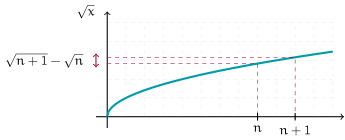
Intuitively, we expect because the graph of the square root function gets ‘flatter and flatter’ as gets large: see Figure 2.8. Thus, for large value of there is very little difference between and . We shall make this intuition precise using the - definition.
In the proof, similarly to Exercise 2.31, we use the factorisation for difference of squares to rewrite
It seems like this should give a more complicated expression, but in this case it becomes simpler because for and we have . This is a bit of a trick, so don’t worry if you didn’t spot it – at least now you know!
For , note that
Thus,
Let be given and choose . If with , then
Thus, by the - definition of a limit, as . ∎
Show that as .
As always, the order and form of the quantifiers in the - definition of a limit is very important!
Let be a sequence and . Match each statement in Group A with an equivalent statement from Group B.
Group A:
-
(i)
For all there exists some such that for all .
-
(ii)
For all , for all , we have for all .
-
(iii)
There exists some such that for all we have for all .
-
(iv)
There exists some and there exists some such that for all .
-
(v)
For all there exists some such that for all .
-
(vi)
There exists some such that for all we have for all .
Group B:
-
(a)
as .
-
(b)
is bounded.
-
(c)
is constant with for all .
-
(d)
The sequence is eventually constant: in particular, there exists some such that .
There is one loose end we need to deal with. In Definition 2.23 we talked about the (definite article) limit of a sequence, which implicitly assumes limits are unique. This requires proof!
If is a convergent sequence of real numbers and , are both limits of , then .
By the - definition of a limit applied to both and , given , there exists and such that
In particular, if we take with , then, by the triangle inequality,
Since the above inequality holds for all , we must have and so , as required. ∎
The proof of Lemma 2.37 involves an ‘abstract’ - argument. Previously, we have focused on verifying the - definition for explicit sequences, such as or . In Lemma 2.37, the goal is quite different. Here we are told in advance that some ‘abstract’ sequence converges; in particular, we know the - definition holds for this sequence. The proof works by using the - definition to derive some new information (in this case, that the limit of the sequence is unique).
The ability to argue abstractly with the - definition makes it very powerful. It allows us to prove general statements about sequences, rather than studying them on a case-by-case basis. In this way, we can develop a general theory of convergent sequences. We shall explore this theory in the following sections.