3.1 Infinite series of real numbers: definition and basic examples
Using the definition of a limit of a sequence from the previous section, we can introduce the concept of a convergent series.
Let be a sequence of real numbers.
-
1
The sequence of partial sums is given by
-
2
We say that the series converges (respectively, diverges) if the sequence of partial sums converges (respectively, diverges).
-
3
If the series converges, then we let denote the value of the limit , which we refer to as the limit of the series.
Once again, here ‘’ is just a symbol and does not represent a mathematical object. Despite the suggestive notation, one should avoid thinking of as ‘summing together infinitely many terms’: in the definition, we always sum together only finite terms (indeed, summation only makes sense for finitely many terms) and then take a limit of the finite sums.11 1 When we study the Riemann rearrangement theorem later in this chapter, we shall see that series can behave very differently compared to the bona fide (finite) sums .
Geometric series
In some rare instances, it is possible to derive a compact formula for the partial sums of a series, which can then be used to determine the convergence properties. One important example of this is given by geometric series.
Given , , we say is a geometric series.
For any , with , there is a simple formula for the partial sums of the geometric series . To derive this formula, we fix and consider and . Writing out these expressions, we see
If we form the difference then all terms cancel except for the first term in and the last term in . Thus, we have . If , then this rearranges to give
Recall from Exercise 2.31 that the sequence converges to for and diverges for . Combining the above observations, we arrive at the following.
Given we have
As an explicit example, taking and , we deduce that .
Note that Example 3.4 does not treat the cases or , which can be dealt with separately. For simplicity, in what follows we take .
The series diverges.
A direct computation shows that the sequence of partial sums is given by for all . By the boundedness test for sequences, the sequence of partial sums diverges. Thus, the series diverges. ∎
The series diverges.
A direct computation shows that the sequence of partial sums is given by if is odd and if is even. By the subsequence test, the sequence of partial sums diverges. Thus, the series diverges. ∎
Decimal expansions
We use series to give a precise definition of infinite decimal expansions.
Given and a sequence with for all , we write if
In Definition 3.8 we only consider real numbers in , but one can derive the expansion for a general number from this by including the integer part.
The geometric series formula (3.2) provides some explicit examples of infinite decimal expansions. For instance,
You studied methods for computing decimal expansions of rational numbers based on this formula in IMU.
The following theorem tells us that every real number can be expressed in terms of decimal digits.
Let . There exists a sequence with for all such that . In other words, .
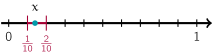
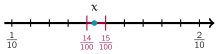
The idea behind Theorem 3.10 is very simple. We start with , which we imagine as some point on the unit interval in the number line. Divide the unit interval into ten equal intervals
Our point must lie in one of these intervals, say . In this case we set and note that , so the fraction is within of . We now split into ten equal intervals
Again, our point must lie in one of these intervals, say . In this case we set and note that
so the fraction is within of . See Figure 3.1. We can continue in this way, obtaining better and better decimal approximants to which, in the limit, converge to .
Whilst the idea is simple to state, working out the precise details of how this works in general is a little involved.
Let . We recursively construct a sequence of integers such that
Once we have such a sequence, it is clear that as a consequence of the squeeze theorem.
To start the sequence, observe there exists a unique such that
Then satisfies , as required.
Suppose have been constructed and satisfy the desired properties. In particular, so that . Thus, there exists a unique value of such that
Rearranging, we see that
as required. ∎
One unfortunate property of decimal expansions is that they are, in general, not unique. For instance, we know two distinct expansions for the number : that is, and . Because of this non-uniqueness, whilst decimal expansions are useful for representing real numbers, they are a messy tool for defining real numbers. This is one reason why it is helpful to define the real numbers using the completeness axiom.
There is nothing special about the decimal expansion, involving powers of , in the above. We can use the same ideas to study binary expansions where , ternary expansions where , and so on.
Telescoping series
We consider another example where it is possible to derive a compact formula for the partial sums.
We say is a telescoping series if there exists a sequence such that for all .
For a telescoping series with for all , we can use cancellation between terms to evaluate the partial sums explicitly in terms of . In particular,
| (3.3) | (3.3) |
This means that the convergence of is equivalent to the convergence of .
We show that .
By writing , we see that is a telescoping series (with ). Using cancellation between terms as in (3.1), the th partial sum is given by
The terms on the right-hand side form a convergent sequence with limit equal to and so as . Thus, by definition, . ∎
Show that . Hint: rewrite the terms using the partial fraction decomposition.
The series diverges.
Writing , this series is clearly a telescoping series. Using cancellation between terms as in (3.1), the th partial sum is given by
The terms on the right-hand side form an unbounded sequence and so diverges by the boundedness test. Thus, by definition, diverges. ∎
Let be such that . By writing , show that is a telescoping series which diverges.