3.7 Recap and reflection
In this chapter we introduced the concept of a series, which is a type of sequence formed by repeated summation. Using series, we were finally able to make sense of infinite decimal expansions such as .
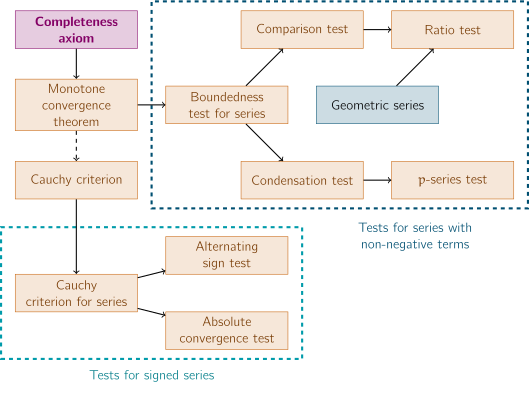
We developed a rich convergence theory for series, providing a range of simple tests to determine whether or not a given series converges. For series with non-negative terms, we introduced the boundedness, comparison, ratio, condensation and -series tests. All these results are based on the monotone convergence theorem for sequences. For signed series, we introduced the Cauchy criterion for series, the alternating series test and the absolute convergence test. All these results are based on the Cauchy criterion for convergent sequences. The relationships between all these results, along with some of the theory developed in previous sections, is presented in the flowchart in Figure 3.5. In particular, we see that our entire theory is underpinned by the completeness property of the real numbers!
In practice, to determine whether a given series converges or diverges, it is often helpful to combine multiple tests. We saw a variety of instances of this through the examples and exercises.
Finally, we introduced the notion of absolutely convergent and conditionally convergent series. We saw that conditionally convergent series can exhibit subtle and complex behaviour, exemplified by the remarkable Riemann rearrangement theorem.
Phew! We now have a good understanding of the real line and how to work with real numbers.