3.6 The Riemann rearrangement theorem
This section is non-examinable
Absolutely convergent and conditionally convergent series have very different properties. To illustrate this, we shall discuss what is perhaps one of the most surprising results in undergraduate mathematics: the Riemann rearrangement theorem.
We first consider rearrangements of (finite) sums of real numbers. Addition of real numbers is commutative. If we pick numbers , say, then the value of their sum does not depend on the order in which we carry out the addition. For instance,
We express this property as follows: given any bijection , we have
Here the bijection corresponds to a choice of order in which to carry out the sum; for instance, in (3.13) we choose so that , , , , . Of course, there is nothing special about taking numbers here, and it is equally true that given for we have
We refer to the sum on the right-hand side of (3.14) as a rearrangement of the sum of the left.
Suppose we now have a sequence of real numbers such that converges. Given a bijection we can consider a rearrangement of the series. We might naively expect an analogous formula to (3.14) to hold in this context. However, it turns out that this fails dramatically for conditionally convergent series!
Let be a sequence of real numbers and suppose is conditionally convergent. For any , there exists a bijection such that the rearrangement converges to .
It is worth pausing to appreciate how surprising and counter-intuitive Theorem 3.56 is. We emphasise that we are completely free to choose . Thus, the theorem tells us that by rearranging the sum we can change the value of the limit! Remember that a rearrangement is simply formed by taking the terms in the partial sums in a different order. For example, we might take
The fact that is a bijection ensures that we do not miss any term in the series and no term appears more than once.
To see how this is this possible, below we shall run through the proof of a special case of Theorem 3.56. The example in fact already contains all the essential ideas, and the method used can be adapted to prove the whole theorem.
Take for , so that we have the series from earlier. We know this series is conditionally convergent, so Theorem 3.56 applies. We now choose some value of . Let’s take , since this corresponds to the year Riemann published his work on the rearrangement theorem. Then by Theorem 3.56 there exists some bijection such that
Alternatively, for some personalised mathematics we could take to be your birthday and find another bijection such that the rearranged sequence converges to that value.
Here we describe explicitly how to construct such a bijection , and thereby prove Theorem 3.56 in this case.
We first consider separately the sequences of (positive) even terms and (negative) odd terms .
(a) The partial sums of the corresponding sequence of even terms are given by
In particular, up to multiplying by , they agree with the partial sums of the harmonic series. We therefore know that the sequence is unbounded and satisfies as .
(b) The partial sums corresponding to the sequence of odd terms are given by
where we have used the inequality . In particular, is also unbounded and satisfies as .
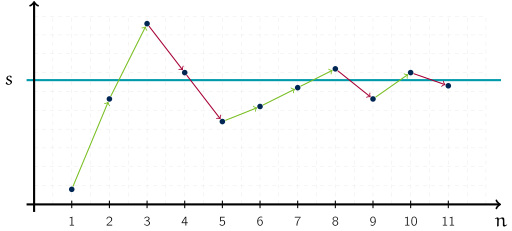
We now carry out a sequence of steps to construct the rearrangement, as illustrated for an example in Figure 3.4:
-
•
We begin by adding together (positive) even terms of the series until we pass the threshold . More precisely, since as , we can find some least value such that
(3.15) (3.15) -
•
We have now overshot our desired limit value. To correct for this, we add together (negative) odd terms until we again drop below the threshold. More precisely, since , there exists a least value such that
(3.16) (3.16) -
•
We have now undershot our desired limit value. To correct for this, we again add together (positive) even terms until we again rise above the threshold. In particular, we let be the least value such that
-
•
Repeating this process of overshooting and undershooting the desired limit, we recursively define increasing sequences of integers and such that
and
for each . This defines a rearrangement of the series. Indeed, it is clear that every term will appear in our reordering of the sequence, and each term appears at most once.
It remains to show the rearranged series converges to the target value . The intuitive idea is very simple: since as , the amount we overshoot or undershoot the target in each step must tend to . However, writing out the details is a little involved, so we only provide a sketch.
Let’s go back to the first step and try to measure the extent to which we overshoot the limit at the beginning of the construction. Since is the least value satisfying (3.15), we must have
Thus, the amount by which we overshoot the limit is bounded by .
Similarly, in the second step we chose to be the least value such that (3.16) holds. This means that
Moreover, taking into account the signs of the terms and our observations about the first step, we have
This means that, at the second step, the sum undershoots 1868 by at most and overshoots 1868 by at most .
Continuing in this way, in later steps of the construction we will either overshoot by at most or undershoot by at most . Since these values are tending to as , we conclude that holds.
Let for all . Explain why there exists a rearrangement of the series such that as (see Definition 2.53). Here you only need to give a reasonably convincing sketch (similar to the example discussed above), rather than spelling out all the technical details.
The Riemann rearrangement theorem applies only to conditionally convergent series. For absolutely convergent series, the situation is completely different. Indeed, suppose is a sequence of real numbers and that the series is absolutely convergent. Then for any bijection the rearrangement is convergent and, furthermore,
We will not prove this result in the course, but the details are not too difficult. If you are interested, feel free to ask the lecturer!