3.5 Convergence results for signed series
So far we have primarily focused on series with non-negative terms . All our results can be restated for series with non-positive terms simply by multiplying through by . However, for series with mixed signs (where terms can be either positive or negative) matters of convergence are typically much more subtle. This is because we often have to understand cross-cancellation between terms. We saw a simple instance of cancellation phenomena in the case of the telescoping series in Example 3.14; however, telescoping series are a very specialised examples and for general signed series understanding cancellation is a difficult problem.44 4 In fact, there are whole areas of mathematics (such as Fourier analysis, studied in Year 4) which are dedicated to this problem, and some of the most important unsolved questions in modern mathematics involve understanding cancellation in series (such as the Lindelöf hypothesis, a cousin of the famous Riemann hypothesis and one of the biggest open problems in number theory).
In this course, we shall only scratch the surface of the theory of signed series. We will establish two basic convergence tests: the alternating series test and the absolute convergence test. These tests only deal with very special cases of signed series, but nevertheless provide the groundwork for more sophisticated theory encountered in later courses. We shall also illustrate very surprising behaviour of signed series in the form of the remarkable Riemann rearrangement theorem.
The Cauchy criterion revisited
For series with non-negative terms , we observed that the partial sums form a monotone sequence. The monotone convergence theorem then reduced matters to determining whether is bounded (c.f. Lemma 3.26); this observation formed the basis of all our earlier convergence tests.
For signed series, the partial sums no longer form a monotone sequence and so we no longer have access to the monotone convergence theorem. However, we can instead appeal to the Cauchy criterion from Chapter 2. Recall that the Cauchy criterion is another tool for determining whether a sequence converges when the precise value of the limit is unknown. We begin by reformulating the Cauchy criterion in the language of series.
Let be a sequence of real numbers. Then the series converges if and only if for all there exists such that
Let denote the sequence of partial sums of the series. Observe that
Thus, the condition (3.10) is equivalent to the sequence of partial sums satisfying the Cauchy criterion. However, by Theorem 2.80, the sequence of partial sums is convergent if and only if it is Cauchy. The result now follows from the definition of convergence of a series. ∎
The alternating series test
We first consider a simple model case for studying signed series. Given a non-negative sequence , we can form a signed sequence by flipping the sign of every odd term.
Let be a non-increasing, non-negative sequence such that as . Then converges.
Since the sequence is non-increasing, non-negative and as , the alternating series test implies that the alternating harmonic series converges.
By contrast, we know from Theorem 3.37 that the unsigned harmonic series diverges. Hence, the cancellation between terms in the alternating series is essential to ensure convergence: we shall discuss this point in more detail below.
We now turn to the details of the proof of Theorem 3.46. Consider the sequence of partial sums of the series of the series . Our goal is to show the sequence converges. Here we do not have any possible candidate for the value of the limit. In such situations we only know two options: either we use the monotone convergence theorem for sequences or we use the Cauchy criterion. However, since the signs of the terms alternate, in general the sequence will not be monotone. Thus, the Cauchy criterion is our preferred option.
The key observation is that the truncated sums satisfy
Temporarily assuming (3.11), we can conclude the proof as follows. Let be given. Since as , there exists some such that for all . Let , with . By (3.11), we have
Since was arbitrary, this establishes the Cauchy criterion for the series . Thus, by Theorem 3.45, the series converges.
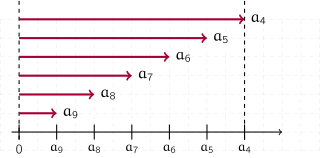
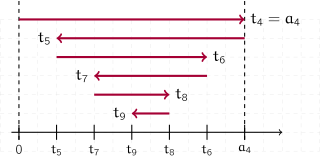
It remains to verify (3.11). We shall demonstrate the result in the special case where and and leave the proof of the general case as an exercise. See also Figure 3.3 for a visual representation of the argument.
For the specific values and , we have
We first group the terms as
Since, by hypothesis, is non-increasing, , and . In particular, the sum is a sum of three non-negative terms and therefore
Using (3.12), we now group the terms as
Arguing as before, and . On the other hand, since is non-negative, . Combining these observations, we see that
which verifies (3.11) in this special case. The same ideas can be used to prove the general case, as discussed in Exercise 3.48 below. ∎
The goal of this exercise is to complete the proof of Theorem 3.46 by proving (3.11) in full generality. To this end, let be a non-increasing, non-negative sequence.
-
(i)
Suppose , are either both odd or both even with . Generalise the argument used for the special case above to show (3.11) holds in this case.
-
(ii)
Adapt the argument used in part (i) to work for all pairs , with .
Hint: for part (i), it is useful to begin by noting
Determine whether each of the following series converges or diverges.
-
(i)
;
-
(ii)
;
-
(iii)
;
-
(iv)
.
Absolutely convergent series
Consider the following two series
From our earlier results, we know that both series converge:
-
•
The series converges by the -series test (Corollary 3.42);
-
•
The series converges by the alternating series test (Theorem 3.46).
However, the mechanism behind the convergence in either case is quite different.
For , the terms are all positive and so the partial sums form an increasing sequence. Here the series converges simply because the magnitude of the terms of the sequence decays at a fast rate.
For , the magnitude of the terms of the sequence decays at a much slower rate. In particular, the absolute value of the th term is and the series formed from these absolute values is the harmonic series , which we know from Theorem 3.37 diverges. Nevertheless, whilst the terms are relatively large in absolute value (in particular, the series formed from the absolute values diverges), the alternating sign means that there is a lot of cancellation between terms. This cancellation is essential for the convergence to hold in this case.
To distinguish between the two scenarios outlined above, we introduce the following definition.
Let be a sequence of real numbers.
-
1
We say the series converges absolutely if the series converges.
-
2
We say the series converges conditionally if it converges but the series diverges.
Using this language, we see that the series above converges absolutely whereas the series converges conditionally. Intuitively, a series converges conditionally if the cancellation between terms is essential for convergence to hold. On the other hand, a series converges absolutely if it converges even when we ignore any possible cancellation between terms.
Determine whether the following sequences converge absolutely, converge conditionally or diverge.
-
(i)
;
-
(ii)
;
-
(iii)
;
-
(iv)
.
The definition of absolute convergence does not directly address whether converges, it only references the series . However, intuitively, if a series converges absolutely, then it is reasonable to expect that it also converges. Indeed, the terms of are all non-negative and so there is no cancellation between terms. On the other hand, the terms of can have different signs, which means there can be cancellation. Intuitively, cancellation should make it more likely for the series to converge. We show this is indeed the case.
Let be a sequence and suppose the series converges absolutely. Then converges.
Consider the series . This converges absolutely, since the series of absolute values converges by comparison with . Hence, by Theorem 3.52, the series converges.
We remark that we cannot apply the comparison test directly to the series , since the terms take positive and negative values (the comparison test applies to unsigned series).
This is yet another instance where we wish to show convergence without knowing the precise value of the limit. Since the terms of the series may be signed, we cannot appeal directly to the monotone convergence theorem, so we use the Cauchy criterion.
Let be a sequence of real numbers and suppose the series converges absolutely. We shall show the series satisfies the Cauchy criterion from Theorem 3.45.
Let be given. Since the series converges absolutely, we may apply the Cauchy criterion to find some such that
Now let and apply the triangle inequality to deduce that
This establishes the Cauchy criterion for the series and so the series is convergent. ∎
Determine whether the following series converge or diverge.
-
(i)
;
-
(ii)
;
-
(iii)
.
Give an alternative proof of Theorem 3.52 by considering the positive and negative terms of separately. In particular, define the non-negative sequences and by
and make use of results that we established for non-negative series.