1.1 Choosing your preferred workflow
There are several tools available to perform conversion of LaTeX to HTML. Here, we focus on BookML, which uses LaTeXML in the background; note that this is the same technology used by arXiv to produce HTML versions of research papers from the .tex source.
There are three steps to generating HTML notes from LaTeXusing BookML:
-
1.
write notes in LaTeX, optionally using the School template;
-
2.
use BookML to convert LaTeX code to HTML;
-
3.
share the HTML version with students.
Your precise workflow will depend on how you wish to share the HTML version with students, whether you prefer to work in Overleaf or write LaTeX locally, and whether you prefer the HTML conversion to be dealt with in the cloud (via GitHub) or on your local machine (via Docker). Some possible workflows are summarised in the figure below.
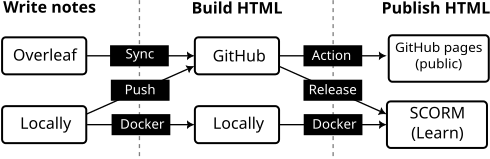
We give detailed guidance for two of these workflows: one with cloud-based conversion and one with local conversion. You can mix-and-match or deviate from these documented workflows if you feel comfortable doing so. If you’re not sure where to start, cloud-based is easiest (Section 1.2).