3.1 Workshop 1 (Exploration)
3.1.1 Preparatory exercises (30 mins)
Definition (Set).
A collection of objects is called a set.
-
1.
The objects within a set are called its elements.
-
2.
If the element belongs to the set , we write . If the element is not in the set , we write . The symbol is read as “is an element of”.
-
3.
Two sets are equal if they contain exactly the same elements.
-
4.
Sets do not contain identical repeated elements.
We can use curly brackets (also called braces) to indicate that we are defining a set. The elements of a set can be any objects. For example, the objects of the set
are names of days of the week.
Some sets are so common that we give them their own symbol (e.g. for the set of natural numbers, for the set of integers, for the set of rational numbers, and for the set of real numbers).
Exercise 3.1.
Consider the set . What elements does it consist of? What types of elements does it contain?
Exercise 3.2.
Think of an example of the sets and that satisfy the following criteria:
-
1.
but .
-
2.
and and share exactly one element.
Sometimes it is not helpful or possible to list all the objects within a set e.g. when we have infinitely many objects. Instead, we can express the elements of a set in terms of the criteria they must satisfy to be in that set. So if my set consists of all elements of a set that satisfy a particular criteria, I could write
For example, the set consists of all integers that are multiples of 3.
This is known as set-builder notation.
Exercise 3.3.
Sort each of the following lists of objects into two sets that do not share any of the same object. What rules could you use? Express your sets in set-builder notation.
-
(a)
-
(b)
Apple, Banana, Carrot, Cherry, Lemon, Onion
Exercise 3.4.
Identify at least two different rules of what should (and shouldn’t) be included in the following partial lists. Add two objects to each list that follow each rule you’ve identified and express the sets that these objects belong to in set-builder notation.
-
(a)
-
(b)
3.1.2 B2 Exploration Workshop Supplementary Material
Definition (Interval Notation).
Let and be two real numbers such that . Then
Definition (Subset).
We call a subset of if every element in the set also belongs to the set . We then write .
Definition (Power Set).
The power set of a set is the set of all subsets of .
Definition (Universal Set).
If a set consists of elements from the set , we call the universal set for .
Definition (Set difference and Complement).
Let . Then the set difference of and is
Let be the universal set of . Then the complement of is .
Definition (Union and Intersection).
Let be sets.
The union of and (written as ) is the set of elements that are elements of or elements of . i.e.
To take the union of all sets , we can write
The intersection of and (written as ) is the set of elements that are elements of and elements of . i.e.
The intersection of all sets is written
An introduction to a standard deck of cards (French-suited)
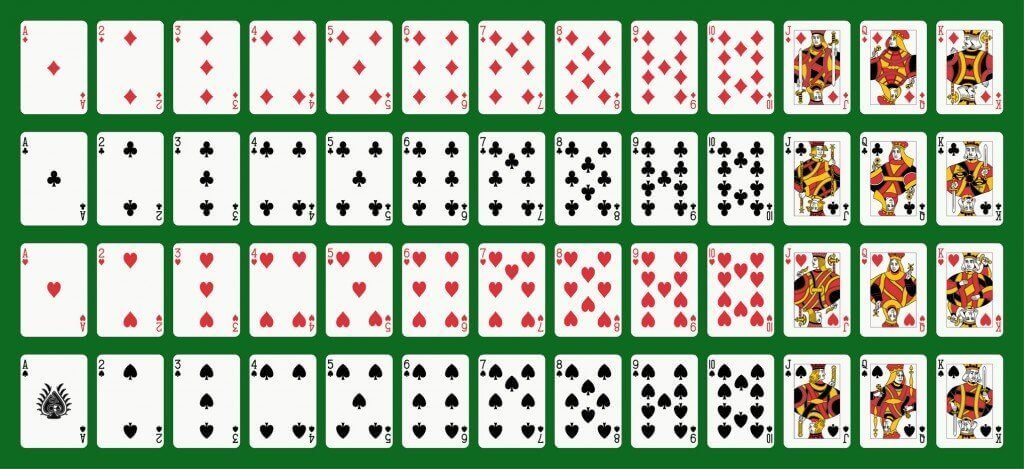
A standard deck of (French-suited) cards consists of 13 black spade cards, 13 black club cards, 13 red heart cards and 13 red diamond cards. We say this deck has 4 suits: spades, clubs, hearts and diamonds. Each suit of 13 cards consists of 10 numbered cards (one card for each number in the list - we call the card for number 1 an “ace”) and 3 royal cards - one jack, one queen and one king.
Definition (Cardinality).
Let and be two sets. If every element of corresponds uniquely to an element of and vice versa, we say and have the same cardinality and write .
If is a finite set of elements, we write .
Definition (Cartesian Product of two sets).
The Cartesian Product of two sets and is
3.1.3 Workshop Tasks
Task 3.5 (5 mins).
(Warm Up) In preparatory exercise 1.2, what examples of sets and did you come up with that satisfy the following criteria?
-
1.
but .
-
2.
and and share exactly one element.
Compare your examples with the rest of your group.
Task 3.6 (10 mins).
Set-builder Notation
-
1.
Compare the sets you wrote in set-builder notation in prep exercises 1.3 and 1.4 with your group. Did you split the lists of objects differently in Exercise 1.3? Did you find the same rules in Exercise 1.4?
-
2.
Write the following sets in set-builder notation:
-
(a)
The set of rational numbers.
-
(b)
The set of all prime numbers.
-
(a)
-
3.
For each of the following sets, find one object that belongs to the set and one object that does not.
-
(a)
-
(b)
-
(a)
-
4.
EXTENSION: The th triangle number is defined to be the number of identical objects that can be arranged in an equilateral triangle with objects along its base. For example, and .
Write out the set of triangle numbers in set builder notation.
Task 3.7 (10 mins).
Subsets
-
1.
Consider the following four intervals:

Write them in both set builder and interval notation.
-
2.
Arrange and into a chain of subsets. Find an element of each set which is not an element of any of its subsets.
Can you represent these sets as a picture?
-
3.
For every set , what is the minimum number of elements that contains?
-
4.
EXTENSION: Consider the set . Is ? [See Russell’s Paradox.]
Task 3.8 (15 mins).
Consider a standard deck of cards (see the supplementary material if you are not familiar with this) and let
In your groups, describe which cards belong to each of the following sets.
-
(a)
.
-
(b)
.
-
(c)
The universal set.
-
(d)
.
-
(e)
.
Are any of these sets subsets of each other? Are there any pairs of sets that don’t share any elements? How many cards belong to each of these sets?
Task 3.9 (15 mins).
Consider a standard deck of cards and let
-
1.
Can you spot any relationship between the number of cards in , , and ? Is this relationship true for any sets? Make a conjecture and try to prove it. Are there any other patterns you notice?
-
2.
EXTENSION: What if we deal with three sets and ? What relationship is there between the cardinality of these sets, the cardinality their union and the cardinality of their intersection ? Try and prove any claims you make.
Definition (Cartesian Product of two sets).
The Cartesian Product of two sets and is
Task 3.10 (10 mins).
Cartesian Product Consider a standard deck of cards and let
-
1.
Express the set . What type of elements make up these sets? How many elements are in this set? How many decks of cards do you need to represent this set?
-
2.
Identify two sets and such that and every element of represents a unique card in .
-
3.
Are the sets and equal? Why or why not?
-
4.
EXTENSION: The Cartesian Product uses and is a type of product. In what ways is it similar to multiplication? How is it different? Do you know of any other operations where the output is a different type of object to the inputs?