2.4 Irrational numbers
Definition 2.17 (Irrational number).
A real number that is not rational is said to be irrational.
At this point, we can deduce that irrational numbers must exist by using the results of the previous section.
Proposition 2.18.
A real number is irrational if and only if it has a non-terminating decimal representation with no repeating pattern.
Example 2.19.
Here is an example of a real number whose decimal representation neither terminates nor repeats:
where the blocks of zeros increases in length after each in the decimal representation.
This must be an irrational number.
Working with decimals like this is fraught with difficulties. For example, the usual algorithms we have for adding and multiplying decimals start with the rightmost digit – what happens when there is no rightmost digit!? For example, try to calculate in (2.1).
We can establish some properties of irrational numbers directly from the definition.
Proposition 2.20.
The product of a nonzero rational number and an irrational number is irrational.
Proof.
Let where and are integers with and , and let be irrational. For a contradiction, assume that is rational. Write where and are integers with . Then
| (by assumption) | ||||||
| (replacing ) | ||||||
| (rearranging, and using the assumption ). |
Now and are an integers because , , and are, and since and . This implies that is rational, a contradiction. Hence must be irrational.
Exercise 2.21.
Prove that the sum of a rational number and an irrational number is irrational.
Solution (please try for yourself before looking)
Let where and are integers with , and let be irrational. For a contradiction, assume that is rational. Write where and are integers with . Then
| (by assumption) | ||||||
| (replacing ) | ||||||
| (rearranging). |
Thus is a sum of the rational numbers and , and so is rational by 2.5. This is a contradiction since is irrational. Hence must be irrational.
2.4.1 The square root of 2 is irrational
We saw in the previous section that irrational numbers do exist. In this section, we shall prove that is one such irrational number.
Recall that an irrational number must be real, according to Definition 2.17. So we should first convince ourselves that is a real number.
By definition, is an object whose square is . In other words, is defined by the property that it is a solution to the equation . However, we cannot just assume that every equation has a real solution. For example, the equation has no real solutions because for any real number .
We can convince ourselves that taking the square root of a non-negative real number results in a real number as follows. Consider the curve with equation and let be any real constant. Starting at the -axis, draw a horizontal line to the right at height until it intersects the curve. Then the -coordinate of the point of intersection is the square root of , as illustrated in Figure 2.1.
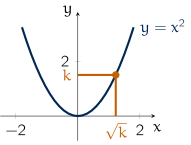
The height can be any non-negative real number and the corresponding value of will also be a real number. Note that the boundary case tells us that . We can also see in Figure 2.1 that there are no real numbers whose square is negative, since any horizontal line drawn below the -axis will not intersect the curve.
Therefore, using the above argument with a horizontal line at height , we can see that is indeed a real number.
Another way to think about is to measure the length of a diagonal in a unit square. By the Pythagorean Theorem the length of this diagonal is
Defining real numbers more formally is not needed for this course.
Theorem 2.22.
The number is irrational.
Proof.
We established above that is real.
For a contradiction, assume is rational. Write , where and are integers so that the fraction is in simplest terms (i.e. and have no common factors).
Squaring both sides of tells us that .
Hence is an even number, and so is even.
Let for some integer . Then and so is even. So is even.
Now both and are even. This contradicts our assumption that could be written in the form with the fraction in simplest terms. Hence this assumption must be false and so cannot be rational.
A calculator will tell you that (rounded to decimal places). But where do these digits come from? Do you know a way to compute them by hand? These kinds of questions will be touched upon in the course Introduction to Mathematical Analysis.
Having as an example of an irrational number can help answer the following questions.
Exercise 2.23.
-
1.
Is the product of two irrational numbers always irrational?
-
2.
Is the sum of two irrational numbers always irrational?
Solution (please try for yourself before looking)
-
1.
The product of two irrational numbers can be rational or irrational. For example:
-
•
is rational;
-
•
is irrational by 2.21, and is irrational by 2.21 and Proposition 2.20.
-
•
-
2.
The sum of two irrational numbers can be rational or irrational. For example:
-
•
and are irrational by 2.21, and is rational;
-
•
is irrational by Proposition 2.20, and is irrational.
-
•
Example 2.24.
We shall show that it is possible for an irrational power of an irrational number to be rational.
We know that is irrational. Consider the number . This is real and so it is either rational or irrational.
-
•
If is rational then we have shown it is possible for an irrational power of an irrational number to be rational.
-
•
If is irrational then and so, in this case, we have an irrational power of an irrational number that is rational.
This is an example of a nonconstructive proof: it tells us something exists without constructing it explicitly. It turns out that is irrational, but this is not straightforward to prove. You may wish to read about the Gelfond-Schneider theorem and Hilbert’s seventh problem if you are interested.
[In case you are not familiar with what it means to take real powers: for any positive real number , we define for any real number . Here is the exponential function and is the natural logarithm. You can read more about exponentiation on Wikipedia if you are interested, but this will be studied in detail in the course Introduction to Mathematical Analysis.]